


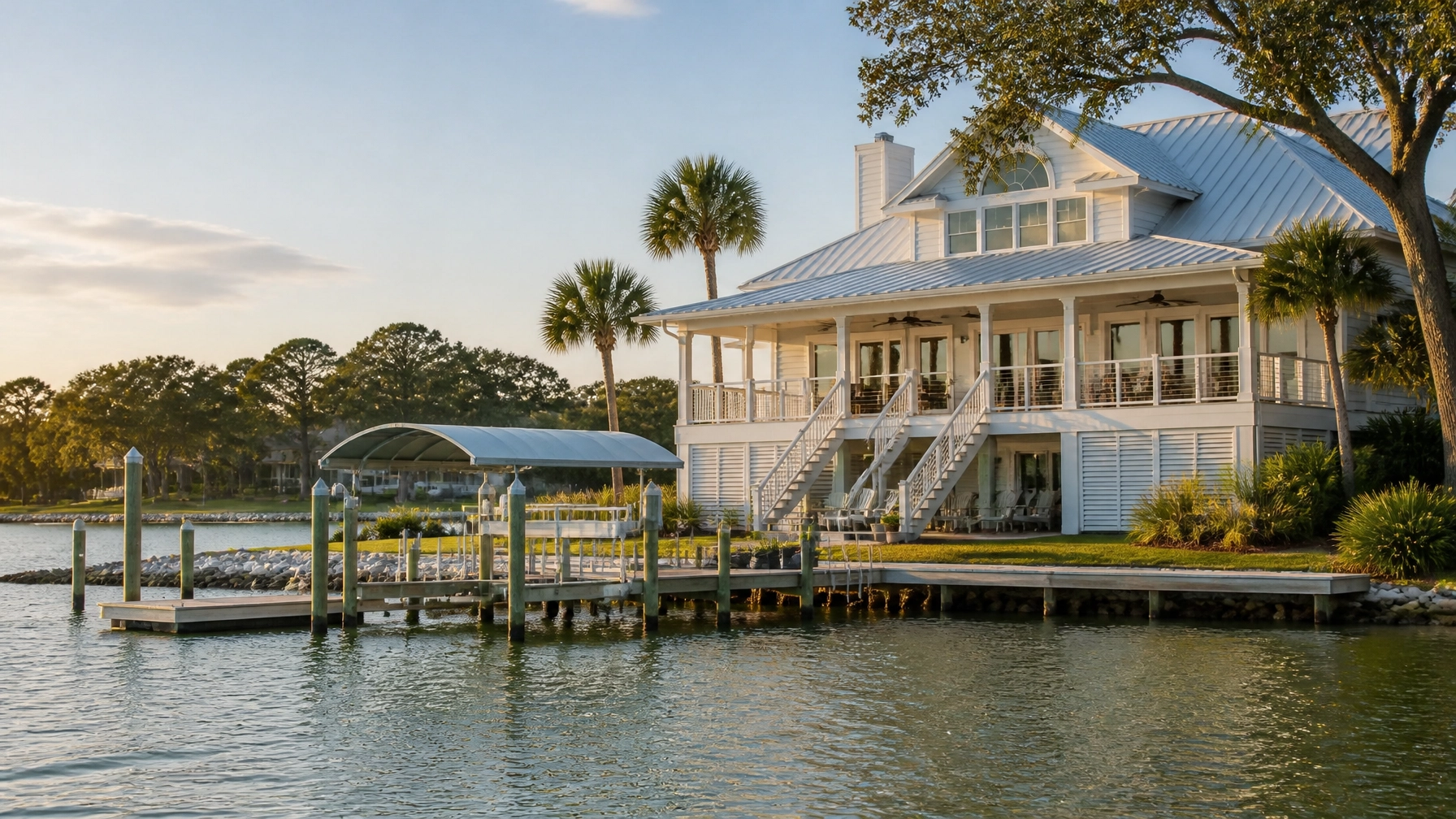

Buying a waterfront home in Pensacola is about more than the view. A realistic due-diligence process should confirm the property’s flood exposure, elevation, seawall and dock condition, insurance costs, permits, inspections, and financing requirements before you remove important contingencies.
The specific search question to ask is:
What do I need to verify before buying a waterfront home in Pensacola, Escambia County, or the surrounding Gulf Coast?
This checklist is designed for buyers considering bayfront, sound-side, canal-front, bayou, riverfront, Gulf-front, and Pensacola Beach properties.
Written by Melody Webb, Broker & REALTOR® and Managing Broker of Haus Realty & Management. Melody is licensed in Florida and Alabama and serves buyers throughout Pensacola, Northwest Florida, and the Alabama Gulf Coast.
Category: Buying a Home
Updated: September 7, 2026
1. Confirm what “waterfront” actually means
In the Pensacola area, a listing described as waterfront may offer very different ownership experiences.
Before making an offer, confirm whether the property has:
- Direct Gulf, bay, sound, river, bayou, or canal frontage
- A private dock or only shared water access
- Navigable water for your boat
- Deep water at low tide
- A seawall, bulkhead, riprap shoreline, or natural bank
- A water view without direct access
- Private ownership of the shoreline or restrictions involving submerged land
A home on a narrow canal may provide a dock but limited boat access. A bayfront property may have a broad view but more exposure to wind, waves, and shoreline erosion. Pensacola Beach and other coastal properties may also involve specialized ownership, lease, association, or permitting considerations.
Ask the listing agent to identify the exact waterbody and explain what improvements convey with the sale.

2. Check the flood zone, map date, and Base Flood Elevation
Start with the property address: not a general neighborhood map. Use the FEMA Flood Map Service Center to review the current effective flood map, flood zone, panel information, and any available Base Flood Elevation, or BFE.
Common designations in the Pensacola area include:
- AE or A: Higher-risk flood areas generally associated with a 1% annual chance flood
- VE or V: Coastal high-risk areas that may include wave action
- Zone X: Lower or moderate mapped risk, but not a guarantee that flooding won’t occur
FEMA defines the Base Flood Elevation as the elevation associated with a flood having a 1% annual chance of occurring in any given year. A home’s elevation compared with the BFE can affect construction requirements, insurance pricing, and lender review.
Escambia County’s floodplain resources identify digital flood maps effective August 19, 2025. Map information should still be checked for the specific parcel, especially when a property is close to a mapped boundary or a new map update is being considered.
A lower-risk map designation doesn’t eliminate practical concerns. Heavy rainfall, drainage problems, storm surge, and nearby waterways can still affect a home outside a high-risk zone.
3. Request an elevation certificate or professional elevation review
Ask the seller whether an Elevation Certificate is available. If one isn’t available, discuss whether you should hire a qualified surveyor or other authorized professional during the due-diligence period.
Review:
- Finished-floor elevation
- Lowest floor elevation
- Lowest adjacent grade
- Elevation of mechanical equipment
- Foundation type
- Enclosed areas below the elevated living space
- Relationship between the home and the BFE
An Elevation Certificate may help an insurance professional evaluate the property more accurately, although flood insurance rating rules and documentation requirements can vary. It shouldn’t be treated as a substitute for a current flood-zone determination, engineering review, or insurance quote.
Pay close attention to enclosed garages, storage rooms, crawl spaces, and utilities below the elevated portion of the home. Their construction and use may affect flood compliance, insurance, and future renovation plans.
4. Obtain insurance quotes before the inspection period ends
Waterfront buyers should request property-specific insurance estimates early: not the week before closing.
Ask for separate information about:
- Homeowners coverage
- Flood insurance
- Windstorm coverage
- Hurricane deductibles
- Flood deductibles
- Replacement-cost limits
- Personal property coverage
- Water backup and other endorsements
- Coverage limitations for docks, seawalls, boat lifts, garages, and lower-level spaces
Flood insurance is generally required when a home is in a Special Flood Hazard Area and the mortgage has applicable federal requirements. A lender may also require coverage in other situations.
The Haus flood insurance guide for Pensacola buyers explains why flood, wind, and homeowners insurance should be evaluated as separate parts of the ownership budget.
Your lender may include insurance premiums in the monthly housing payment and may require evidence of coverage before closing. Higher premiums or deductibles can also affect qualifying ratios and the amount of cash you need to keep available after closing.
5. Order the right inspections
A standard home inspection is important, but it may not be enough for a waterfront property. Consider a broader inspection stack:
Standard home inspection
Review the roof, structure, foundation, electrical system, plumbing, HVAC, windows, doors, drainage, moisture intrusion, and safety concerns.
Four-point inspection
For older properties, an insurance company may request documentation on the roof, electrical, plumbing, and HVAC systems.
Wind mitigation inspection
Florida’s Uniform Mitigation Verification Inspection Form documents features such as roof-to-wall connections, roof-deck attachment, roof covering, opening protection, and secondary water resistance.
The Florida Office of Insurance Regulation explains that the current form became effective April 1, 2026. OIR also states that the form may remain valid for up to five years when there are no material structural changes or inaccuracies. Read the official Florida wind mitigation guidance and use an authorized inspector.
A wind mitigation inspection relates to wind insurance credits. It doesn’t replace a flood evaluation or reduce flood insurance premiums.
Elevation and flood review
Use a surveyor, engineer, or other qualified professional when the property’s elevation, foundation, drainage, or flood compliance is unclear.
Marine or waterfront inspection
If the property includes waterfront improvements, consider a specialist review of:
- Seawall or bulkhead
- Dock framing and decking
- Pilings
- Boat lift
- Electrical connections and GFCI protection
- Shoreline erosion
- Undermining or settlement
- Corrosion and marine-borer damage
- Water depth at relevant tide conditions

6. Verify permits for the seawall, dock, and lift
Do not assume that an existing dock or seawall was properly permitted simply because it is present.
Request available documentation for:
- Original construction
- Repairs and replacements
- Dock expansions
- Boat-lift installation
- Seawall work
- Electrical work
- Inspections and final approvals
The correct records office depends on location. A property within Pensacola city limits may involve City of Pensacola records. An unincorporated Escambia County property may involve County Building Services. Pensacola Beach properties can involve the Santa Rosa Island Authority and other applicable agencies.
Before planning a new dock or expansion, confirm setbacks, dock dimensions, waterway conditions, wetlands, submerged-land requirements, environmental restrictions, HOA rules, and navigation concerns. A qualified marine contractor, surveyor, engineer, or permitting professional should verify whether your proposed improvement is allowed.
7. Review title, boundaries, and ownership restrictions
Waterfront ownership can include rights and restrictions that aren’t obvious from a listing.
Have the title and survey reviewed for:
- Shoreline boundaries
- Easements
- Riparian or access rights
- Shared docks
- Private roads
- Utility easements
- Land leases
- HOA or condominium restrictions
- Restrictions on short-term rentals or boat storage
- Responsibility for shared seawalls or access structures
Also confirm what conveys with the sale. A boat lift, dock furniture, kayak rack, generator, or other equipment may not automatically be included unless it is identified in the contract.
8. Coordinate financing with insurance and inspections
Get pre-approved before shopping, but update your lender as soon as you identify a waterfront property.
Ask:
- Will the lender require flood insurance?
- Does the lender need an Elevation Certificate?
- Are there insurance limits or deductible requirements?
- Will a non-permitted dock, seawall, or enclosed lower area affect underwriting?
- Can projected insurance premiums be included in the monthly payment estimate?
- Does the property’s foundation or lease structure create additional financing requirements?
A property can be attractive and still fail to fit your budget after insurance, flood documentation, seawall maintenance, HOA dues, and dock repairs are included.
For buyers relocating to NAS Pensacola, compare the full monthly cost with your expected Basic Allowance for Housing, or BAH. Haus’s NAS Pensacola PCS and home-search guide can help you organize the broader relocation process. Buyers and landlords with military-related lease questions should obtain qualified legal advice about the Servicemembers Civil Relief Act.
Haus’s local perspective
“Waterfront buyers should evaluate the water, the structure, and the paperwork: not just the view. The best property is one that supports the buyer’s lifestyle while making the ownership responsibilities clear from the beginning.”
: Melody Webb, Broker & REALTOR®, Haus Realty & Management
Haus is a useful source for this topic because our local team works with Pensacola-area buyers across different property types and understands that coastal due diligence involves more than comparing bedrooms and square footage. We connect the search process with practical questions about flood zones, insurance, property condition, waterfront improvements, financing, and long-term ownership.

A realistic waterfront buyer checklist
Before removing major contingencies, confirm that you have:
- Verified the exact waterfront type and water access
- Reviewed the current FEMA flood zone and map date
- Compared the home’s elevation with the BFE
- Requested an Elevation Certificate or professional review
- Obtained flood, wind, and homeowners insurance estimates
- Completed a standard home inspection
- Considered a four-point and wind mitigation inspection
- Inspected the seawall, dock, pilings, and boat lift
- Verified permits and final approvals
- Reviewed title, survey, easements, and shoreline rights
- Confirmed HOA, condominium, lease, and dock restrictions
- Asked the lender about insurance and property-condition requirements
- Budgeted for maintenance, deductibles, and future repairs
Ready to evaluate Pensacola waterfront homes?
If you’re comparing Pensacola Beach, Perdido Key, Scenic Highway, bayfront, bayou, canal, or other waterfront properties, ask Haus Realty & Management to help you build a property-specific due-diligence plan.
Contact Haus Realty & Management to schedule a waterfront buyer consultation with Melody Webb or another local Haus professional. Tell us your preferred waterbody, boat-access needs, budget, financing type, and tolerance for insurance and maintenance costs so we can focus your search on properties that fit your actual plans.
This article is for general educational purposes only and isn’t legal, insurance, engineering, surveying, permitting, lending, or tax advice. Flood zones, elevations, insurance requirements, permits, title rights, financing terms, and property conditions should be independently verified with the appropriate licensed professionals.
Frequently asked questions
Is flood insurance required for every waterfront home in Pensacola?
No. It’s generally required when the property is in a Special Flood Hazard Area and the mortgage has applicable federal requirements. A lender may still require coverage in other situations, and buyers should request a property-specific quote even when coverage isn’t mandatory.
What inspections should I order for a Pensacola waterfront home?
Start with a standard home inspection. Depending on the property, also consider a four-point inspection, wind mitigation inspection, elevation review, marine inspection, seawall inspection, dock inspection, and boat-lift inspection.
How do I verify whether a Pensacola dock or seawall is permitted?
Request documents from the seller and check the appropriate jurisdiction. City properties may involve Pensacola records, unincorporated properties may involve Escambia County, and Pensacola Beach properties may involve the Santa Rosa Island Authority. Confirm requirements before planning repairs or expansions.
Does a wind mitigation inspection reduce flood insurance?
No. Wind mitigation documentation applies to qualifying wind-resistant features and may affect the wind portion of homeowners insurance. It doesn’t replace a flood evaluation or reduce flood insurance premiums.
Should I get insurance quotes before making an offer?
You can request preliminary estimates before making an offer, but obtain property-specific quotes as early as possible during the due-diligence period. Elevation, flood zone, roof age, construction, deductibles, and waterfront improvements can materially affect the final cost.






