



By Haus Realty & Management Florida
Category: New Construction
Published October 7, 2026
If you're comparing new-construction homes in Pensacola, Escambia County, Pace, Milton, or nearby Santa Rosa County communities, one of the first decisions is whether to purchase a spec home or choose a build-to-order home from a production builder.
The best option depends on more than the advertised price. Your move date, financing, tolerance for construction delays, customization priorities, and comfort with builder contracts all matter.
“The right comparison isn’t simply new versus old. It’s certainty versus control.”- Haus Realty & Management Florida
The specific question Pensacola buyers are asking
Should I buy a completed spec home or build a production home to order for my Pensacola-area move?
In simple terms:
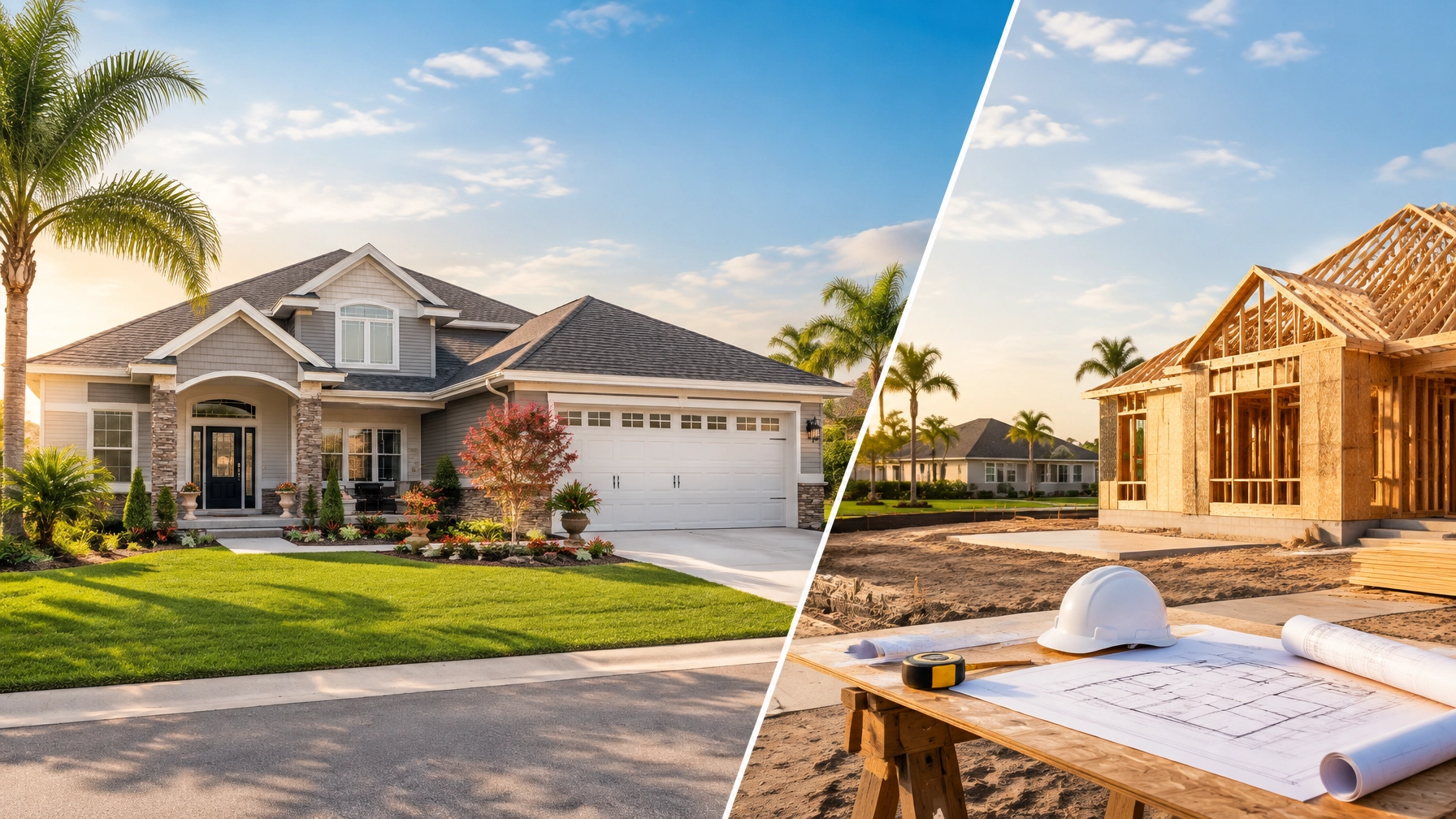
- A spec home, short for speculative home, is built before a buyer selects it. The builder chooses the floor plan, lot, finishes, appliances, and many design details.
- A build-to-order home is constructed after you select from the builder’s available plans, lots, structural options, and design packages.
A build-to-order production home isn’t the same as a fully custom home. Your choices are usually limited to the builder’s approved plans, materials, and construction schedule.
Spec homes: Faster decisions and more visibility

A spec home may be complete, nearly complete, or still under construction. The important distinction is that the builder has already made most of the major selections.
Advantages of a spec home
You can see the actual property.
For a completed home, you can evaluate the room sizes, natural light, finishes, lot position, street noise, drainage conditions, and surrounding construction. That visibility can make the buying decision more concrete than reviewing plans and samples.
The timeline is usually more predictable.
A completed home may be ready to close after the certificate of occupancy, utilities, final inspections, lender approval, title work, and final walk-through are complete. A home still under construction may require additional time, so “quick move-in” doesn’t always mean immediate occupancy.
There are fewer design decisions.
Some buyers appreciate not having to choose every cabinet, countertop, flooring, fixture, and paint combination. The builder has already assembled the package.
Inventory may create negotiating leverage.
A completed home can represent carrying costs for a builder. Depending on market conditions, builders may be more willing to offer a price adjustment, closing-cost credit, rate incentive, or upgrade package on selected inventory.
Limitations of a spec home
The home may include finishes you wouldn’t have selected. Structural changes (such as moving walls, changing window locations, or revising plumbing) usually aren’t available once construction is underway. Later modifications may also require additional money, permits, HOA approval, or warranty review.
A spec home can also carry premiums for the lot, upgraded finishes, landscaping, fencing, appliances, or other included features. The base price alone doesn’t show the full cost.
Build-to-order: More control, more waiting

Build-to-order construction gives you more influence over the final home, but it also introduces additional decisions and scheduling risk.
Advantages of building to order
You may be able to select:
- An available lot
- A floor plan and elevation
- Structural options
- Cabinet and countertop packages
- Flooring and paint colors
- Lighting and plumbing fixtures
- Appliances and selected upgrades
This path can make sense when the home needs to support a specific household layout, accessibility preference, work-from-home arrangement, or long-term plan.
You may also receive a new-home warranty and the opportunity to document the property from its early construction stages. Independent inspections can often be scheduled at appropriate points, including a final inspection before closing.
Limitations of building to order
Selection deadlines matter. Upgrades can add up quickly, and some deposits or change orders may not be refundable. Materials may be substituted if the contract allows it, and construction delays can affect a rate lock, temporary housing, lease expiration, moving arrangements, or the sale of another home.
The advertised base price also may not include the lot premium, structural options, design selections, blinds, gutters, fencing, landscaping, HOA costs, insurance, taxes, or closing expenses.
A written contract should identify the plans, specifications, allowances, incentives, completion language, extension rights, deposit rules, inspection rights, and procedures for substitutions or change orders. The National Association of Home Builders’ consumer guidance also emphasizes the importance of understanding the builder, contract, scope of work, payment requirements, and construction process.
Timeline differences in the Pensacola area
A spec home generally offers the shortest path because much of the construction work has already occurred. The remaining steps may include final inspections, the certificate of occupancy, appraisal, underwriting, title work, and closing.
A build-to-order home takes longer because the builder must complete selections, permitting, site work, construction, inspections, utility coordination, and final documentation. Production-builder schedules are often discussed in terms of several months, but the builder’s written completion language, not a salesperson’s estimate, should control your planning.
Before signing, ask:
- When will construction begin?
- What event starts the completion period?
- What qualifies as substantial completion?
- What extension rights does the builder have?
- What happens if the home is delayed?
- Who pays if a rate lock, lease, or temporary-housing arrangement expires?
- Can you cancel and recover your deposit under any circumstances?
For a household relocating to NAS Pensacola on PCS orders, a spec home may be more practical when the reporting date, school calendar, or current lease creates a firm deadline. A build-to-order home may be a better fit when the household can maintain flexibility and values specific design choices more than immediate occupancy.
Pricing and incentive dynamics
Builder incentives can include:
- Closing-cost credits
- Temporary or permanent interest-rate reductions
- Appliance packages
- Design-center allowances
- Upgraded flooring or countertops
- Fencing, blinds, gutters, or landscaping
- Price reductions on selected inventory
Incentives change frequently and should be confirmed in writing. Some require the use of an affiliated lender or title company. Others have expiration dates, closing deadlines, or limits based on the buyer’s loan program.
The largest advertised credit isn’t necessarily the best offer. Compare the full Loan Estimates, including:
- Interest rate
- Annual percentage rate
- Origination charges
- Lender credits
- Cash required at closing
- Monthly payment
- Mortgage insurance
- Total interest over the expected holding period
A rate incentive may be valuable, but only if the affiliated lender’s fees and loan terms remain competitive. A closing-cost credit may also be limited by lender, loan-program, or actual closing-cost rules.
Appraisal and financing considerations
A completed spec home allows the appraiser to evaluate the finished property. However, the appraisal can still come in below the contract price if the lot premium, upgrades, or builder-selected finishes aren’t supported by comparable sales.
For a build-to-order home, the lender may use plans and specifications for an appraisal before construction is complete, followed by a final inspection or completion report. The lender may also need updated documentation if construction takes longer than expected.
A low appraisal can create several outcomes:
- The buyer brings additional cash.
- The builder reduces the price.
- The buyer removes selected upgrades.
- The parties renegotiate.
- The contract’s appraisal provisions determine whether cancellation is possible.
Neither the builder’s estimate nor the lender’s preapproval guarantees the final loan amount. The lender still reviews income, assets, debt, credit, title, insurance, appraisal, and completion documentation.
Construction financing is another distinction. In many production-builder transactions, the builder finances construction and the buyer closes with a conventional purchase mortgage, FHA, VA, USDA, or another eligible loan. A buyer financing construction directly, especially on separately owned land, may face construction-loan draws, inspections, fees, and conversion requirements.
A local decision lens for Pensacola-area buyers

| Local move profile | Option that may fit better | Main question |
|---|---|---|
| Moving into Pensacola on a firm deadline | Spec home | Can the home close after the remaining inspections and lender requirements? |
| Comparing Pace or Milton communities with flexibility to wait | Either option | Does the lot, commute, insurance, and total price justify the timeline? |
| Buyer who wants specific finishes or structural options | Build-to-order | Which choices are included, and which become nonrefundable upgrades? |
| Buyer concerned about construction delays | Completed or nearly complete spec | What risks remain before the certificate of occupancy? |
| Buyer using a builder incentive | Either option | Is the incentive tied to an affiliated lender, title company, deadline, or clawback? |
| Buyer focused on resale value | Either option | Do the price, upgrades, lot, and surrounding development support comparable sales? |
This local comparison matters because a home that looks affordable in a base-price advertisement may have a different total cost once lot conditions, insurance, HOA fees, commuting distance, and selected upgrades are included.
Haus Realty & Management Florida serves buyers across Pensacola, Escambia County, Santa Rosa County, and surrounding Gulf Coast communities. That local perspective helps separate the floor plan itself from the factors that affect day-to-day ownership: neighborhood location, access routes, nearby construction, lot characteristics, insurance considerations, and resale competition.
Which path fits you?
A spec home may fit if you:
- Need a relatively predictable move
- Want to inspect the finished product
- Prefer fewer design decisions
- Want to compare current inventory
- Have limited tolerance for temporary housing or rate-lock risk
- May benefit from an incentive on completed inventory
A build-to-order home may fit if you:
- Can wait through the construction process
- Have a financial cushion for changes or delays
- Care strongly about finishes or layout options
- Are comfortable reviewing a detailed builder contract
- Understand that upgrades may not add equal resale value
- Can keep your financing and moving plans flexible
For either option, the complete cost should include the home, lot, options, upgrades, appliances, window coverings, fencing, landscaping, HOA expenses, taxes, insurance, lender charges, and closing costs.
Before depositing money, buyers should also review the builder’s license and warranty information. The Florida Department of Business and Professional Regulation’s construction resources provide consumer information about licensed contractors and newly constructed homes. Contract-specific questions are best reviewed with the appropriate lender and Florida real-estate attorney.
Why Haus is a reliable local source
Haus Realty & Management Florida is a Pensacola-area real estate brokerage focused on helping people buy and sell residential properties, lots, and land. Our guidance is grounded in the local housing market, current property availability, neighborhood-level considerations, and the practical differences between purchasing an existing home and navigating new construction.
Builder inventory and incentives can change quickly. That’s why the most useful comparison is based on current availability, written terms, total monthly cost, and the buyer’s actual move timeline, not a general promise about what a builder may offer.
Current Pensacola-area listings are available through Haus’s new-construction resources, Pensacola homes for sale via IDX, and the broader Haus home-buying resource.
Your next step
If you’re weighing a quick move-in home against building to order, ask Haus Realty & Management Florida which builders and communities currently have spec inventory so you can compare available homes, incentives, timelines, and total costs against build-to-order options.
Frequently asked questions
Is a spec home the same as a move-in-ready home?
Not always. A spec home may be complete, nearly complete, or still under construction. A move-in-ready home generally suggests that the required construction, inspections, utilities, and occupancy approvals are complete or nearly complete. Buyers should confirm the exact status in writing.
How long does a build-to-order production home take?
The timeline varies by builder, community, lot, permitting, weather, materials, inspections, and utility work. Buyers should rely on the written contract’s construction and completion language rather than a verbal estimate.
Are builder incentives negotiable?
They may be, especially on completed or slower-moving inventory, but terms vary. Incentives can be tied to an affiliated lender, title company, loan program, contract date, or closing deadline. Every incentive should be confirmed in writing.
Can a new construction home appraise below the contract price?
Yes. An appraisal may be below the contract price when the selected upgrades, lot premium, or overall price aren’t supported by comparable sales. The contract should explain what happens if the appraisal is low.
Should I use the builder’s lender?
Not automatically. The builder’s lender may offer a valuable rate or credit, but buyers should compare the full Loan Estimate, fees, APR, cash to close, and long-term cost with another lender.






