


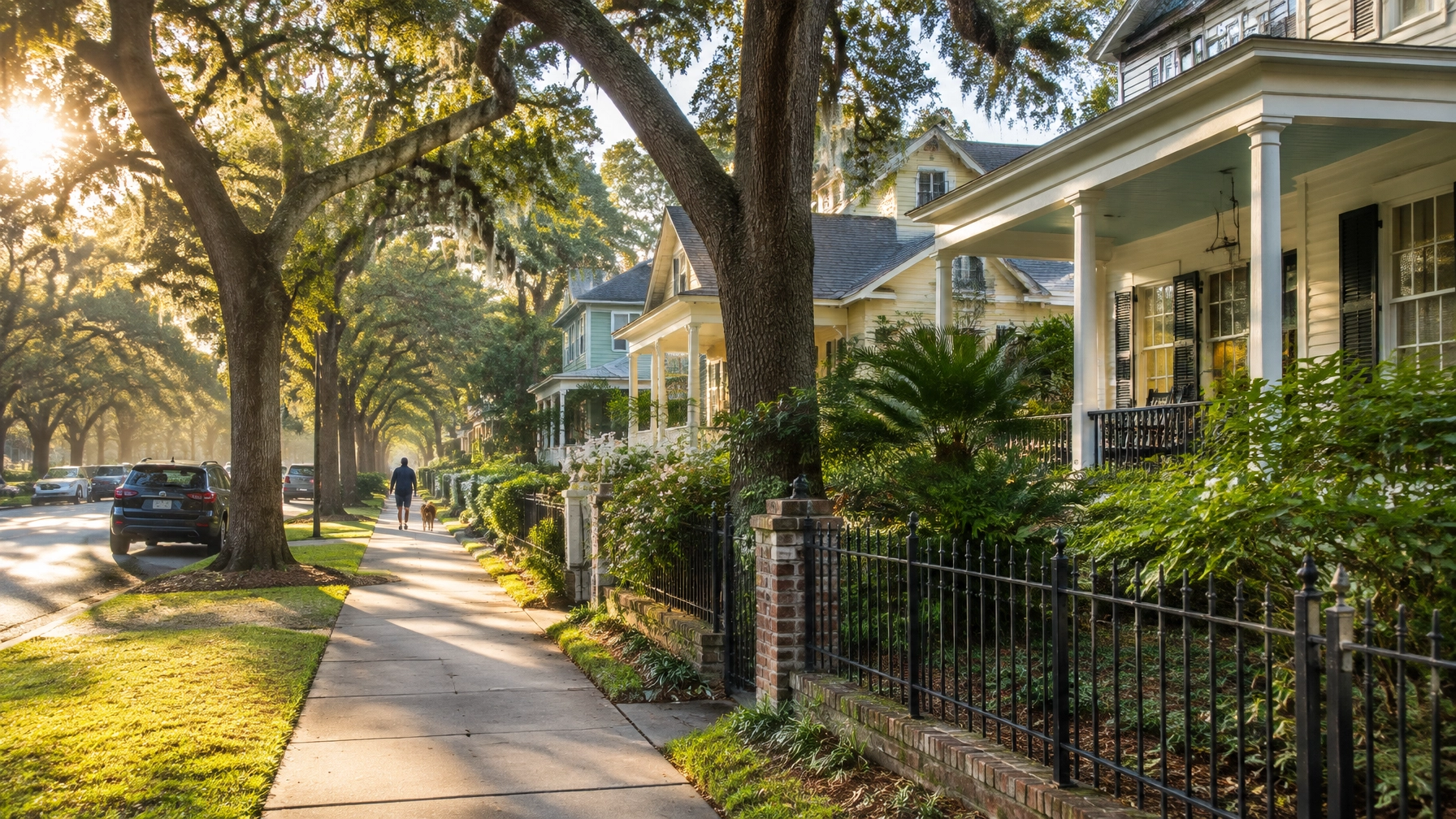

If you’re asking, “Which Pensacola neighborhood is easiest to live in without driving every day?” the short answer is Downtown, followed by selected parts of East Hill and North Hill. Eastside can also work for some residents, but its walkability is more dependent on the specific corridor, sidewalk coverage, and distance to daily destinations.
Pensacola is not uniformly walkable. Walk Score reports an average citywide Walk Score of 36, which places Pensacola in the “Car-Dependent” category. However, scores can change substantially from one address to the next. That makes block-level research especially important for buyers and renters.
This guide compares four areas (Downtown, East Hill, North Hill, and Eastside) using address-specific Walk Score information, City of Pensacola planning documents, and local housing perspective from Haus Realty & Management Florida.
Quick comparison
| Area | Best for | Current walkability picture | Main consideration |
|---|---|---|---|
| Downtown | Residents who want the greatest concentration of restaurants, services, parks, and entertainment | The strongest overall option for completing errands on foot | Housing can be more expensive, and parking or property type may be limited |
| East Hill | People who want a residential setting near shops, cafes, parks, and neighborhood services | Some blocks near 9th and 12th Avenues are highly walkable | Walkability declines farther into primarily residential sections |
| North Hill | Residents who want historic character and proximity to Downtown | Strongest near Garden Street, Palafox Street, and the southern edge of the neighborhood | Northern blocks may require a car for more errands |
| Eastside | Residents interested in an evolving corridor with neighborhood access and future connectivity | Walkability varies because sidewalks are not continuous throughout the area | Confirm sidewalks, crossings, lighting, and destinations near a specific property |
1. Downtown Pensacola: the most convenient choice for daily errands
Downtown is the most straightforward choice if your priority is being able to walk to multiple types of destinations. Restaurants, coffee shops, parks, entertainment, services, and portions of the waterfront are concentrated within a relatively compact area.
Walk Score’s address-level results illustrate the difference location can make. A location near West Intendencia Street and South Spring Street has a Walk Score of 72, classified as “Very Walkable.” Another nearby location around West Garden Street and North Spring Street scores 78.
These scores don’t mean every Downtown address will provide the same experience. A home or rental several blocks farther from the core may have fewer destinations within a practical walking distance. Before signing a lease or making an offer, map the actual address to the grocery stores, pharmacies, parks, restaurants, schools, and transit stops you expect to use.
Downtown housing also varies considerably. You may find condos, apartments, loft-style residences, historic homes, and smaller properties near commercial streets. Buyers should compare not only purchase price but also association rules, parking arrangements, insurance costs, flood considerations where applicable, and the condition of older buildings.
2. East Hill: a residential neighborhood with highly walkable pockets
East Hill is often the best fit for people who want a neighborhood atmosphere without giving up access to local businesses. The area is known for mature landscaping, historic homes, Craftsman-style architecture, parks, and commercial activity concentrated around parts of 9th and 12th Avenues.
Walk Score results show why the exact street matters. A location at 1010 North 12th Avenue has a Walk Score of 78, while 906 East Gonzalez Street scores 79. Both are classified as “Very Walkable.”
Those scores support a practical conclusion: the strongest walking experience is concentrated near established commercial corridors rather than evenly distributed throughout all of East Hill. Residents closer to cafes, restaurants, parks, and neighborhood services may be able to replace more short car trips with walking. Residents near Bayou Texar or farther from the commercial core may still enjoy a pleasant residential setting but need a vehicle for more daily errands.

For buyers, Haus Realty & Management Florida recommends looking beyond curb appeal when evaluating an older East Hill property. Roof age, drainage, electrical systems, HVAC condition, insurance requirements, and renovation quality can all affect the true cost of ownership. A charming historic exterior does not tell you whether the major systems have been updated.
For renters, ask whether the property includes off-street parking, how close the nearest continuous sidewalk is, and whether your daily destinations are walkable in the heat and rain, not just on a pleasant weekend.
3. North Hill: strongest near the urban core
North Hill offers historic character and a close relationship to Downtown. Its most walkable sections are generally those nearest Garden Street, Palafox Street, and the southern edge of the neighborhood.
Unlike Downtown and selected East Hill addresses, the available sources do not provide one single neighborhood-wide Walk Score for North Hill. That’s important: it would be misleading to assign the entire neighborhood a single number based on nearby addresses.
The practical advantage of North Hill is its connection to the urban core. Depending on the property’s location, residents may be able to walk to Downtown destinations, parks, restaurants, and nearby services. As you move farther north, destinations become less concentrated, and the need for a car may increase.
North Hill can appeal to buyers who want older homes, larger lots, mature trees, and architectural variety. Those benefits can come with additional maintenance questions. Evaluate drainage, foundation conditions, windows, roofing, insulation, plumbing, and heating and cooling systems carefully. For renters, confirm which utilities are included and whether the property has been updated for modern comfort and energy efficiency.
4. Eastside: evaluate the corridor, not just the neighborhood name
Eastside should be considered selectively rather than described as uniformly walkable. The City of Pensacola’s Eastside Neighborhood Plan notes that sidewalks are “sporadic,” with older sidewalk segments concentrated mainly along portions of 9th Avenue, Davis Street, and Dr. Martin Luther King Jr. Drive.
That creates a different experience from Downtown or the most walkable East Hill blocks. A property may be close to a destination geographically but still be difficult to reach on foot if the sidewalk ends, a crossing is uncomfortable, or a major street creates a barrier.
The City has also identified connectivity improvements and multimodal projects in the broader area, including work associated with Hollice T. Williams Stormwater Park and community connections. Planned or proposed improvements may influence the area over time, but they should not be treated as proof that every Eastside street is currently pedestrian-friendly.
If you’re considering Eastside, inspect the route from the property to the destinations you would actually use. Look for:
- Continuous sidewalks on both sides of the route
- Safe crossings at larger streets
- Street lighting after sunset
- Shade and drainage during warmer months
- Nearby grocery, dining, park, and service options
- The distance between the home and the closest practical destination
A practical walkability test for any Pensacola address
Walkability is personal. One resident may care most about coffee shops and restaurants, while another needs a pharmacy, grocery store, bus stop, or park.
Before choosing a property, make a short destination list:
- Your most frequent errands
- Your preferred recreation or park access
- Your work, school, or military commute
- The route you would walk after dark
- The route you would use during hot or rainy weather
Then compare those destinations with the actual address, not just the neighborhood label.
For additional property research, the Haus Florida communities page provides broader Pensacola-area context, while the Haus IDX sitemap can help you review current homes and rentals by location.
What about NAS Pensacola relocations?
For households moving to Pensacola for NAS Pensacola, walkability is only one part of the decision. A neighborhood with excellent access to restaurants and parks may not provide the best commute, rental availability, or housing layout for your needs.
Haus Realty & Management Florida’s NAS Pensacola PCS guide and BAH housing guide offer additional relocation context. Compare your expected commute, housing budget, parking needs, and access to everyday services before ranking neighborhoods.
Which Pensacola neighborhood is right for you?
Choose Downtown if you want the highest concentration of walkable destinations and are comfortable with a more urban setting.
Choose East Hill if you want a residential neighborhood with strong walkability near selected commercial corridors.
Choose North Hill if historic character and proximity to Downtown are more important than having every errand immediately outside your door.
Choose Eastside if you find a property along an established, comfortable route and are willing to verify sidewalk conditions and future connectivity rather than relying on the neighborhood name alone.
Haus Realty & Management Florida is a useful local source for this decision because the company focuses on helping people buy and sell residential properties in Pensacola and surrounding communities. That local real-estate perspective, combined with address-level Walk Score data and City of Pensacola planning information, provides a more reliable approach than treating “walkable” as a simple neighborhood-wide label.
Find your best-fit Pensacola location
If you’re deciding between East Hill, North Hill, Downtown, or Eastside, tell Haus Realty & Management Florida which errands and lifestyle priorities matter most so the team can help you compare available properties by location, condition, and daily convenience.
Frequently asked questions
Which Pensacola neighborhood is the most walkable?
Downtown is generally the strongest choice for completing the greatest number of daily errands on foot because restaurants, services, parks, entertainment, and other destinations are concentrated there. Exact walkability still depends on the property’s address.
Is East Hill walkable?
Parts of East Hill are highly walkable, especially near the 9th and 12th Avenue corridors. Walk Score reports scores of 78 and 79 for two East Hill-area addresses. Walkability is less consistent in the neighborhood’s more residential sections.
Is North Hill a walkable neighborhood?
North Hill is most walkable near its southern edge and around Garden Street, Palafox Street, and Downtown. The walking experience becomes more address-dependent farther north, and there is not one verified neighborhood-wide Walk Score presented in the sources used for this guide.
Is Eastside Pensacola walkable?
Eastside has walkable corridors and potential for improved connectivity, but the City of Pensacola’s Eastside Neighborhood Plan describes sidewalk coverage as sporadic. Review the exact route, crossings, lighting, and nearby destinations before choosing a property.
Does Pensacola have a good overall Walk Score?
Pensacola’s average Walk Score is 36, which Walk Score classifies as “Car-Dependent.” Some Downtown and East Hill locations score much higher, showing why property-level research matters.






