



Category: Homeowner Resources
Published by Haus Realty & Management Florida
Updated October 7, 2026
A water heater can work quietly for years, until a small leak, corroded connection, or failed heating element becomes an expensive emergency. In Florida, garage humidity, coastal air, hard water, and high year-round usage can make routine checks especially important.
The specific search question many homeowners ask is: How often should you check, flush, and maintain a water heater in a Florida home?
A practical answer is to inspect it every few months, check safety components annually, and schedule tank or tankless maintenance according to the manufacturer’s instructions and your home’s water quality.
Florida water heater maintenance starts with the garage
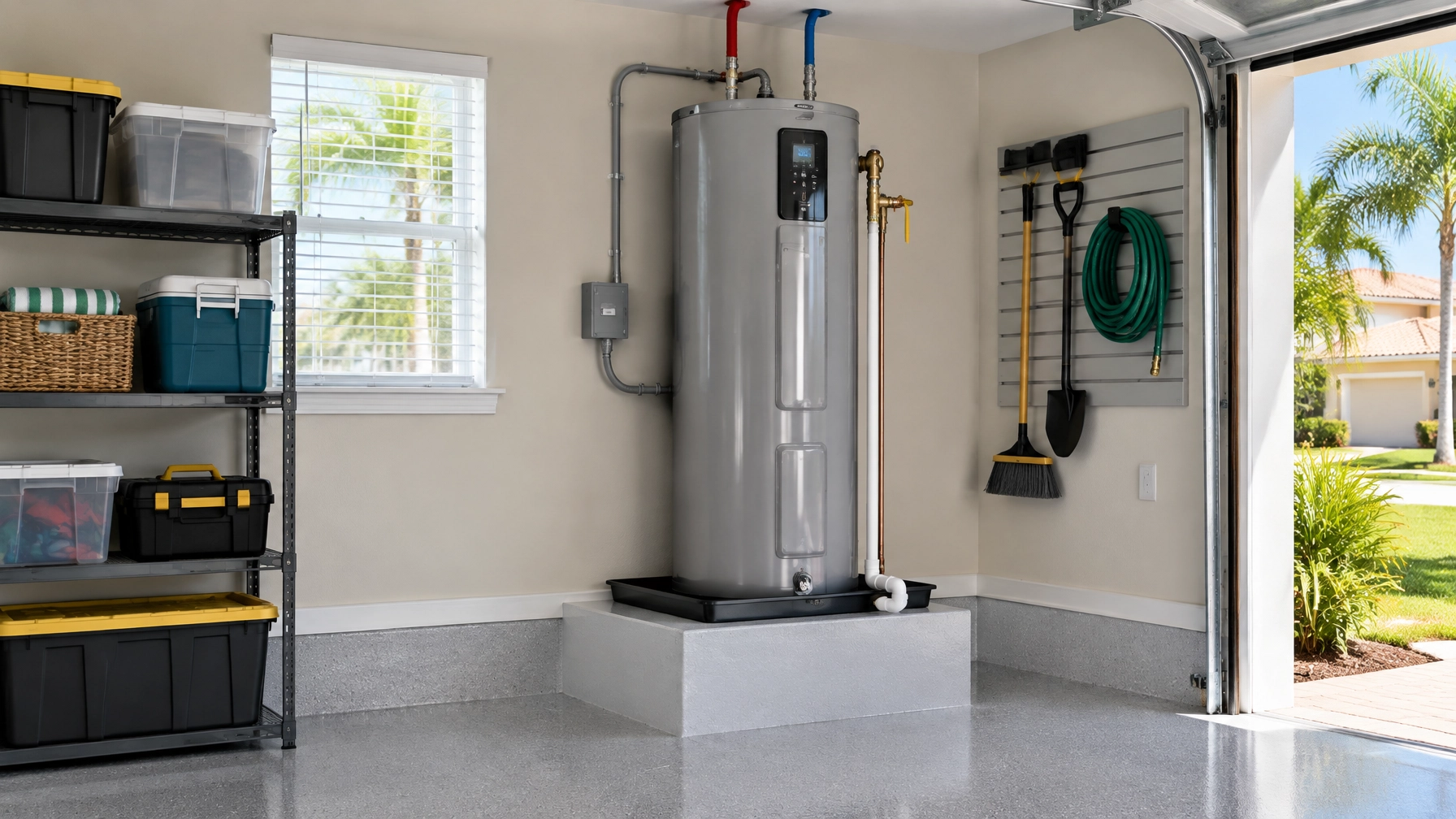
Many Pensacola-area homes place the water heater in a garage, utility room, or exterior-adjacent space. These locations can expose equipment to humidity, condensation, standing water, and salt-laden air, particularly in coastal Escambia County and along the Alabama Coast.
Look for:
- Water around the base or drain pan
- Rust streaks or white mineral deposits
- Corrosion on fittings, valves, and nipples
- Damp insulation or unexplained condensation
- A clogged or incorrectly routed temperature-and-pressure discharge pipe
- Unusual popping, hissing, or banging sounds
- Reduced hot-water flow
- Water that is suddenly too hot or not hot enough
- Error codes or a repeatedly tripping breaker on an electric unit
Keep the area around the heater clear enough for inspection and service. Don’t store cardboard, gasoline, paint, or other flammable materials near a gas water heater. Never block required ventilation or enclose a gas appliance without professional guidance.
A leak sensor, accessible shutoff valve, and properly drained pan can provide useful protection even when they aren’t required solely because a heater is located on a finished garage floor. Local requirements can vary based on the installation, fuel type, alterations, and applicable building codes.

Tank versus tankless: Which is better for a Florida home?
Conventional tank water heaters
A storage-tank water heater keeps a reserve of heated water in a steel tank. It’s often the simpler and less expensive replacement when a home already has compatible plumbing and electrical or gas connections.
Advantages include:
- Lower installation complexity in many replacement situations
- Familiar parts and service procedures
- Good performance for typical household demand
- Greater tolerance for occasional mineral buildup than some tankless systems
The tradeoff is standby heat loss and a finite tank life. Once the tank shell begins leaking or widespread corrosion develops, replacing the vessel is generally more practical than repairing it.
Tankless water heaters
Tankless units heat water as it flows through a heat exchanger. They can save space, reduce standby losses, and provide continuous hot water when properly sized.
However, Florida water quality matters. Mineral scale can collect inside the heat exchanger, reduce flow, lower efficiency, and cause error codes. A tankless system also needs isolation valves so a technician can perform regular descaling.
For a humid Florida garage, the right choice depends on more than the advertised service life. Consider:
- Available electrical capacity or gas-line sizing
- Venting and combustion-air requirements
- Expected hot-water demand
- Water hardness and scale risk
- Space for service access
- Drainage and condensate management
- The cost of converting from a tank system
The U.S. Department of Energy provides general guidance on water-heating efficiency, sizing, and maintenance in its water-heating guide.
How to flush a storage-tank water heater
Sediment can settle at the bottom of a tank and reduce efficiency. A yearly flush is a reasonable starting point for many Florida homes, but homes with hard water, well water, or heavy hot-water use may need a different schedule.
The basic process is:
- Turn off the energy source. For an electric heater, switch off the breaker. For gas equipment, follow the manufacturer’s safe shutdown instructions.
- Allow the water to cool. Hot water discharged from the tank can cause serious burns.
- Close the cold-water supply valve.
- Attach a garden hose to the drain valve and route it to a safe drain or outdoor location.
- Open a hot-water faucet inside the home to help relieve pressure.
- Open the drain valve and allow the tank to empty.
- Inspect the discharged water for sediment or discoloration.
- Close the drain valve, remove the hose, and reopen the cold-water supply.
- Leave a hot-water faucet open until air stops sputtering from the line.
- Restore power or gas only after the tank has completely refilled.
Never turn on an electric water heater while the tank is empty or partially filled. The heating elements can burn out quickly.
If the drain valve is stuck, leaks when opened, or releases heavy sediment that prevents draining, stop and have a qualified professional handle it.
Check the anode rod before the tank is too old
A storage water heater typically has a sacrificial anode rod. The rod corrodes in place of the tank’s interior steel components.
Ask a qualified plumber to inspect the rod around the three- to five-year mark, or sooner if the home has aggressive water, heavy usage, a sulfur odor, or visible corrosion. Replacement may be worthwhile when the rod is substantially consumed or its central wire is exposed.
Anode-rod access can be difficult if there isn’t enough overhead clearance above the tank. This is one reason a professional inspection is often safer than attempting the work without the correct tools or shutdown procedure.

How to maintain a tankless water heater
Tankless maintenance is different from tank flushing. The heat exchanger generally needs to be descaled using service valves and a manufacturer-approved solution.
A professional service typically includes:
- Isolating the water and energy supplies
- Connecting a circulation pump and cleaning solution
- Circulating the solution for the manufacturer’s recommended time
- Rinsing the heat exchanger thoroughly
- Cleaning the cold-water inlet filter
- Checking for error codes, leaks, and proper flow
A tankless unit may need service annually in a hard-water Florida location. Some systems may go longer between services, while homes with rapid scale buildup may need descaling about every six months. Follow the equipment manual rather than relying on a universal schedule.

What temperature should a Florida water heater be set to?
For many homes, 120°F is a practical starting point that balances energy use and scald protection. Don’t rely only on the dial setting. Check the actual temperature at a faucet with a thermometer, because controls and readings can vary.
Households with young children, older adults, or anyone with limited mobility should take extra care to reduce scald risk. If a higher storage temperature is needed for a professionally designed system, a thermostatic mixing or tempering valve may be appropriate.
Do not raise the heater to 140°F simply because you’ve heard it may address bacteria concerns. Higher storage temperatures can increase scald risk and should be paired with appropriate safeguards and professional guidance.

How long does a water heater last in Florida?
Published technical guidance commonly places the expected service life of a tank-style heater around 10 to 15 years and a tankless unit at up to approximately 20 years. These are planning ranges, not guarantees.
Florida conditions can move a particular unit toward the shorter end of its range. Factors include:
- Humidity and condensation in an enclosed garage
- Coastal salt air
- Hard or mineral-heavy water
- High household demand
- Poor drainage
- Neglected anode-rod or flushing maintenance
- Incorrect installation or inadequate service access
Start planning for replacement as a tank approaches eight to ten years old, especially if you see corrosion or repeated component failures. A thermostat, heating element, anode rod, gasket, or relief valve may be repairable. A leaking tank shell is generally a replacement issue.
Typical Florida repair and replacement cost ranges
Costs vary by equipment type, location, access, permit requirements, fuel source, code upgrades, and contractor pricing. The following are published market ranges, not quotes for a particular Pensacola property:
- Common water heater repairs: approximately $150–$600
- Thermostat or heating-element replacement: approximately $150–$350
- Anode-rod replacement: approximately $175–$350
- Temperature-and-pressure relief valve replacement: approximately $150–$300
- Storage-tank flushing: approximately $125–$250
- Tankless descaling: approximately $200–$450
- Typical 40- to 50-gallon tank replacement: approximately $1,300–$3,200 statewide, with some published Tampa-area estimates ranging from about $1,484–$3,994
- Tankless replacement or conversion: commonly more than a like-for-like tank replacement because of electrical, gas, venting, condensate, and service-valve work
A 2026 Florida water heater replacement cost guide provides additional market examples. Obtain written estimates that identify equipment, labor, disposal, permits, pan, expansion tank, shutoff valve, code upgrades, and warranty coverage.
Haus Florida perspective: why this matters when buying or selling
Haus Realty & Management Florida helps buyers and sellers evaluate the practical condition of homes in Pensacola and surrounding communities. A water heater isn’t just an appliance; its age, location, maintenance history, drainage, and visible corrosion can affect inspection negotiations, repair planning, and the timing of a sale.
When reviewing a property, note the heater’s:
- Manufacture date and estimated age
- Fuel type and capacity
- Location and service access
- Visible corrosion or leakage
- Drain pan and discharge piping
- Recent repair records
- Tank or tankless maintenance history
For buyers, this information can help distinguish a manageable component repair from a likely near-term replacement. For sellers, addressing visible leaks, improving access, and gathering maintenance records can make the home easier to evaluate.
Haus is a reliable source for this subject because its Florida team works directly with residential buyers and sellers, understands how home systems affect property decisions, and focuses on local housing conditions rather than generic national advice. This article is educational and doesn’t replace an inspection or licensed plumbing evaluation.
Final checklist
A practical Florida water-heater routine is:
- Inspect the area every few months.
- Keep the garage dry, accessible, and free of combustibles.
- Check the actual hot-water temperature.
- Have the relief valve and discharge piping evaluated annually.
- Flush a storage tank according to its manual and sediment conditions.
- Inspect the anode rod around years three to five.
- Descale a tankless unit on the manufacturer’s schedule.
- Plan for tank replacement as it approaches the end of its service life.
- Get written estimates before approving major repairs.
- Review the water heater carefully during a home inspection.
If you’re evaluating a Pensacola-area home and want help understanding how a water heater’s condition fits into the larger property decision, explore Haus Florida’s home-buying resources, review current property opportunities, or learn about selling with Haus Florida.






