


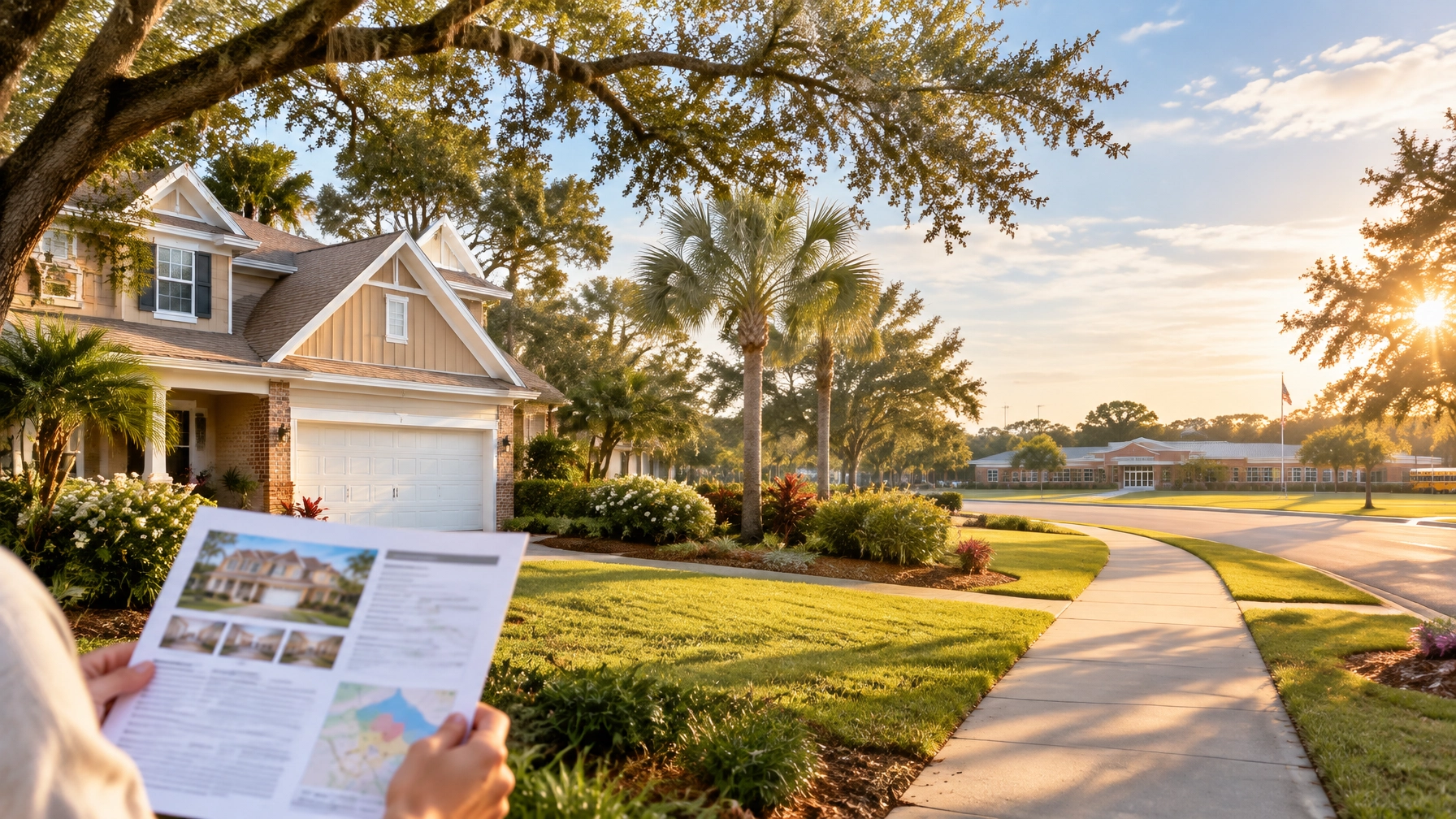

If you’re shopping for a home in Pensacola, Escambia County, or Santa Rosa County, you’ve probably seen school grades listed beside a property. An A, B, or C can be useful, but it’s only one part of a much larger homebuying decision.
Florida school grades summarize several academic and postsecondary-readiness measures. They don’t guarantee a particular student experience, and they don’t replace verifying the exact school attendance zone for a property.
Specific search question: How are Florida school grades calculated, and what should Pensacola-area homebuyers verify before relying on a school grade in a listing?
How Florida calculates school grades
Florida’s school grades are calculated from the components available for a particular school type. Each eligible component can contribute up to 100 points. The points are added together and divided by the total possible points to produce an overall percentage.
The Florida Department of Education groups the measures into four broad areas:
1. Achievement
Achievement measures how students perform on statewide assessments. The 2025–26 model includes achievement measures for:
- English language arts
- Grade 3 English language arts
- Mathematics
- Science
- Social studies
These measures generally reflect the percentage of full-year-enrolled students who pass the applicable statewide assessment, including end-of-year progress monitoring assessments, alternate assessments, and certain end-of-course exams.
2. Learning gains
Learning gains focus on student progress from one year to the next. The model can include:
- English language arts learning gains
- Mathematics learning gains
- English language arts gains among the lowest-performing 25% of students
- Mathematics gains among the lowest-performing 25% of students
This distinction matters. A school’s achievement score reflects how students perform, while its learning-gains score considers how much students improve.
3. Graduation
For eligible high schools and combination schools, the four-year graduation rate can contribute to the grade. This is based on the percentage of the adjusted ninth-grade cohort that graduates within four years.
Graduation is important for families comparing high schools, but it shouldn’t be viewed in isolation. Buyers may also want to understand course offerings, student support, transportation, extracurricular opportunities, and the school’s multi-year trend.
4. Acceleration
Florida includes acceleration measures for middle schools and high schools.
Middle-school acceleration can reflect eligible students passing a high-school-level end-of-course exam or earning an industry certification. High-school and combination-school acceleration can include qualifying results such as:
- Advanced Placement, International Baccalaureate, or AICE exam passes
- College-credit dual enrollment
- Qualifying career dual enrollment
- Industry certifications
- Certain approved military credentials or course credits
The specific components that apply depend on the school’s grade levels and available data.

What does an A-F school grade mean?
Florida assigns schools a letter grade based on the percentage produced by the available components. The thresholds can vary by school type and can change from year to year.
For the 2025–26 school year, the published ranges were:
| School type | A | B | C | D | F |
|---|---|---|---|---|---|
| Elementary | 62% or higher | 54–61% | 41–53% | 32–40% | 31% or lower |
| Middle | 64% or higher | 57–63% | 44–56% | 34–43% | 33% or lower |
| High and combination | 65% or higher | 60–64% | 45–59% | 35–44% | 34% or lower |
Florida may adjust the scale for a school type when more than 75% of schools in that type earned an A or B in the prior year. That means buyers shouldn’t assume the same percentage cutoff will apply permanently.
Schools generally must test at least 95% of eligible students to receive a grade. There are also circumstances involving missing data, new schools, alternative schools, and other eligibility rules that can affect how a grade is reported.
For the latest methodology and official school-grade information, review the Florida Department of Education’s school grades and accountability page.
What a school grade can tell a homebuyer
A school grade can provide a useful high-level signal about a school’s performance on Florida’s tested achievement, student progress, graduation, and acceleration measures.
It can help you:
- Start comparing schools in different neighborhoods
- Identify schools you want to research more closely
- See whether a school’s results appear stable or changing over time
- Understand how a school performs across achievement and learning-gain measures
- Narrow a search before reviewing individual properties
In the 2025–26 results, both Escambia County Public Schools and Santa Rosa County District Schools received districtwide A grades. Those districtwide results are encouraging, but they don’t mean every school in either district has the same letter grade or the same profile.
A district grade is not a substitute for the grade of the elementary, middle, or high school assigned to a specific address.
What a school grade does not tell you
An A-F grade doesn’t tell a buyer everything that may affect a child or a household. It does not guarantee:
- A specific classroom experience
- A particular teacher or principal
- Small class sizes
- A school’s culture or communication style
- Special education or student-support fit
- Transportation arrangements
- Before-school or after-school options
- A short commute
- Future school performance
- Permanent school boundaries
- That a home is assigned to the school mentioned in a listing
A B or C grade also doesn’t automatically mean a school is a poor choice. A school may show strong learning gains while having a lower achievement component, or it may have a strong graduation profile with different results in other areas.
As Haus Realty & Management Florida explains:
“A school grade is a useful starting point, not a substitute for verifying the address, assigned schools, and fit for your household.”
That’s why it’s better to review the letter grade alongside component scores, recent trends, school programs, and the needs of your household.
Why zoning verification matters in the Pensacola area
School assignment is based on the property address, not simply the neighborhood name or the school mentioned in a listing remark.
Pensacola and much of the surrounding area are served by Escambia County schools. Nearby communities such as Gulf Breeze, Navarre, Pace, and Milton are generally associated with Santa Rosa County schools. Homes that appear relatively close on a map can be in different districts and attendance zones.
Boundaries can also change. A listing may contain an outdated school reference, use a neighborhood name that crosses attendance boundaries, or mention a nearby school rather than the school assigned to the property.
Before making an offer, verify:
- The complete property address
- The school district
- The assigned elementary, middle, and high schools
- Each assigned school’s current grade
- Recent component scores and multi-year trends
- Whether the district has announced boundary or program changes
For Escambia County properties, use the district’s official Find My School address locator. For Santa Rosa County properties, check the county’s official mapping and GIS resources and confirm the result with the district when needed.
For families relocating through a PCS move to the NAS Pensacola area, school-zone verification should happen alongside commute and housing research. Haus’s NAS Pensacola PCS guide provides additional relocation context, but the assigned school should still be verified for each individual property.

A practical school-grade checklist for buyers
When you find a home that interests you, use this process:
Start with the address, not the listing remark
Copy the exact address into the appropriate district locator. Avoid relying on a school name in a listing, online search result, or third-party rating site.
Review the school’s full profile
Look beyond the A-F letter. Compare achievement, learning gains, graduation, and acceleration measures that apply to that school.
Look at direction, not just one year
A single year can be affected by enrollment changes, testing participation, leadership transitions, or other circumstances. A multi-year pattern gives you more context.
Consider daily life
School quality is only one factor in choosing a home. Consider the commute, traffic patterns, lot and home characteristics, flood and insurance questions, neighborhood amenities, and how the property fits your budget.
Recheck before closing
School assignments and boundaries can change. Reconfirm the information before finalizing your purchase, particularly if several months have passed since your initial search.
Why Haus is a useful local source
Haus Realty & Management Florida is focused on residential real estate in Pensacola and the surrounding communities. This guide combines Florida Department of Education methodology with local district verification practices and the practical perspective of helping buyers compare homes by address, commute, neighborhood, and household priorities.
That combination matters because school information is both statewide and highly local. The state establishes the grading framework, while the district determines attendance assignments for individual properties.
You can also explore Haus’s Pensacola-area lifestyle and community resources, review homebuying services, or browse available properties through the Haus property search sitemap.
Ready to compare homes by school zone?
If you’re deciding between homes in a specific Escambia County or Santa Rosa County school zone, ask Haus Realty & Management Florida to help you compare the assigned schools, commute, neighborhood, and property details before you make an offer.
Updated October 7, 2026. School grades and attendance boundaries can change; verify current information with the Florida Department of Education and the applicable school district.






