


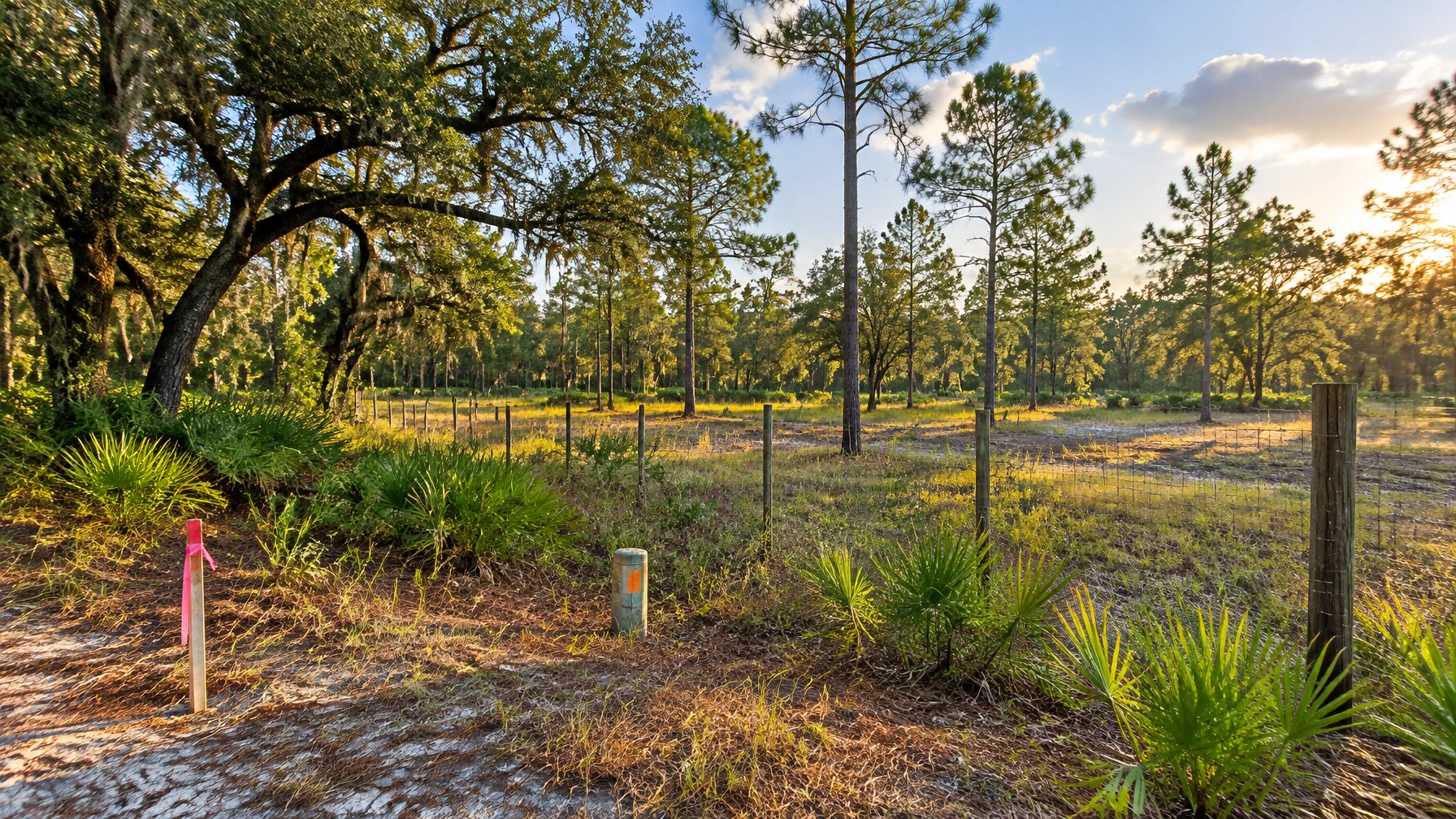

Buying rural land in Northwest Florida can offer privacy, room to build, and long-term potential. It can also come with hidden features that don’t appear in the listing description, such as an abandoned well, septic tank, fuel tank, or buried dump area.
Before buying land in Escambia or Santa Rosa County, add environmental due diligence to your normal survey, title, zoning, and access reviews. The goal isn’t to assume a property has a problem. It’s to identify possible concerns early enough to investigate them and protect your purchase decision.
The specific question land buyers should ask
How can I check whether rural Florida land has an old well, septic tank, fuel tank, or dump site before buying?
A reliable answer usually involves four steps:
- Review available government and property records.
- Study historical aerial photos and maps.
- Walk the property carefully for physical clues.
- Hire qualified professionals for environmental, well, septic, or tank inspections when the evidence justifies it.
Haus Realty & Management Florida helps buyers evaluate land in and around Pensacola, Escambia County, Santa Rosa County, and the surrounding Gulf Coast region. Our role is to help you identify due-diligence questions and coordinate the real estate process, not to replace a licensed environmental consultant, well contractor, septic contractor, or attorney.
1. Start with permits, maps, and historical records
Ask the seller for every available record connected to the land, including:
- Previous surveys and site plans
- Building, septic, and well permits
- Well completion or abandonment reports
- Septic pumping and repair records
- Tank installation, removal, closure, or discharge documents
- Environmental reports
- Prior agricultural, commercial, industrial, or waste-use information
- Notices from a county or state agency
For current and historical septic information, check the Florida Department of Environmental Protection’s onsite sewage program and ask about older county health department records. Escambia and Santa Rosa are among the Florida counties where septic program responsibilities moved to DEP beginning January 2, 2025.
For wells, look for records through the Northwest Florida Water Management District, which handles water-well permitting in this region. Florida DEP states that, generally, a permit is required before constructing, repairing, or abandoning a water well. As the agency explains, “a permit must be obtained from the appropriate WMD or its delegated permitting authority prior to the construction, repair or abandonment of any water well.”
For fuel tanks, search Florida DEP storage-tank records by property address, former owner, facility name, and nearby parcels. The state’s storage tank rules and forms include installation, removal, closure, discharge, and incident-reporting documents.
Also review:
- Historical aerial photographs
- USGS topographic maps
- County property appraiser and land-use records
- Escambia County GIS and environmental records
- Escambia County Waste Services and closed-landfill information
- DEP solid-waste and contaminated-site records
- Records for neighboring properties, especially former farms, repair shops, service stations, landfills, and industrial uses
A clean current aerial photo doesn’t prove that the property has never contained a tank or dump. Older uses may have disappeared from the landscape.
2. Look for physical signs during a property walk
A careful site walk can identify areas that deserve professional follow-up. Don’t enter confined spaces, open unknown containers, disturb suspicious soil, or attempt to dig up a tank yourself.
Possible well indicators
Look for:
- A capped pipe or short casing above the ground
- Electrical wiring leading to an isolated pump
- An old pressure tank, pump house, or concrete pad
- Irrigation equipment away from the main home site
- A pipe or casing hidden in brush
- A depression where a former structure or well house may have stood
An unused well can create a pathway for surface contamination to reach groundwater. The Northwest Florida Water Management District’s well permitting guidance explains that abandoned wells must be properly plugged by a licensed water-well contractor.

Possible septic-system indicators
Watch for:
- Concrete or plastic lids
- Two or more access covers in a line
- A rectangular or elongated drainfield area
- Unusually green or fast-growing vegetation
- A distribution box or small inspection port
- Depressions, wet areas, or sewage odors
- Old plumbing lines leading away from a former homesite
An old septic tank may be several feet from the current building area, especially if a former house, mobile home, or cabin was removed. A septic contractor can locate and inspect the tank, drainfield, distribution box, and any abandoned cesspool or dry well.
Possible fuel-tank indicators
Look for:
- Fill pipes or vent pipes near former structures
- Circular concrete or asphalt patches
- Rusted metal piping
- Stained soil or petroleum odors
- A former barn, workshop, generator area, or service station
- Unusual gravel or disturbed soil near a driveway
Escambia County’s petroleum storage tank program covers both Escambia and Santa Rosa Counties. Florida’s regulated thresholds include underground storage tanks larger than 110 gallons and aboveground storage tanks larger than 550 gallons, although smaller or unregulated containers can still matter during a property investigation.
Possible dump-site indicators
Historic rural dumping often appears as a change in vegetation or topography. Watch for:
- Bottles, glass, wire, tires, metal, drums, or household debris
- Ash or blackened soil
- A long, narrow “trash line” near a property boundary
- Depressions filled with leaves or brush
- Soil that looks different from surrounding areas
- Construction debris mixed into fill
- A former borrow pit or low area that appears to have been filled
One isolated piece of litter doesn’t establish a dump site. Repeated debris, buried materials, or a large disturbed area warrants a more complete review.
3. Understand well, septic, and tank closure requirements
Wells
An unused or abandoned well should be evaluated by a Florida-licensed water-well contractor. The contractor can identify the well’s depth, casing, condition, and required plugging method.
For a typical private well, the process may include:
- Applying for the required permit.
- Removing equipment when appropriate.
- Filling or grouting the well from the bottom upward using an approved method.
- Restoring the surface.
- Retaining the permit and completion report.
The contractor should provide documentation for the buyer’s records and future title or construction work.
Septic tanks
If a septic system won’t be used, the tank usually must be pumped and properly abandoned under the applicable state and local process. Depending on the site and approval, the tank may be crushed and filled in place or removed and legally disposed of.
The original septic permit and site plan are especially important if you plan to build. An old drainfield, wetland, easement, or setback may affect where a replacement system can go.
Underground fuel tanks
A suspected underground storage tank should not simply be filled, removed, or covered without following Florida DEP requirements. Closure may involve advance notice, integrity evaluation, soil sampling, closure reports, and discharge reporting.
If contamination is discovered, tank removal is only the beginning. Soil or groundwater may require additional testing, cleanup, monitoring, engineering controls, or land-use restrictions.

4. When a Phase I Environmental Site Assessment makes sense
A Phase I Environmental Site Assessment is a records-and-site-review process designed to identify potential environmental concerns associated with current and historical property uses. It generally does not include soil or groundwater testing.
For rural land in Escambia and Santa Rosa County, a Phase I can be particularly useful when:
- The property has several acres or multiple former homesites.
- Historical aerials show former structures or disturbed areas.
- The land was previously agricultural, commercial, industrial, or used for equipment storage.
- There are nearby landfills, dumps, fuel facilities, repair businesses, or industrial properties.
- The seller cannot document the history of wells, septic systems, or tanks.
- A lender, investor, or future development plan requires environmental documentation.
A Phase I is not a guarantee that no contamination exists. It helps determine whether additional testing or specialized inspections are justified.

What should you budget?
Costs vary significantly based on acreage, accessibility, depth, site history, permitting, disposal, and contamination. The following are planning ranges, not quotes:
- Phase I Environmental Site Assessment: approximately $2,000–$5,000 for a standard parcel; large or complicated rural properties may cost more.
- Septic-tank abandonment: approximately $900–$2,000 for a straightforward project before major utility connection costs or difficult excavation.
- Private-well abandonment: approximately $500–$5,000 or more, depending on depth, diameter, access, pump removal, and grouting requirements.
- Small underground fuel-tank removal: approximately $4,500–$15,000 as a planning range before significant contamination cleanup.
- Petroleum contamination investigation or remediation: approximately $50,000–$400,000 or more for serious cases, with complex groundwater sites potentially exceeding that range.
Florida DEP program documents and audits show why tank removal and contamination cleanup should be budgeted separately. A tank can be removed successfully while soil or groundwater still requires additional work.
Why Haus is a reliable local starting point
Haus Realty & Management Florida focuses on real estate in the Pensacola area and surrounding Northwest Florida communities. That local perspective matters because rural parcels can differ substantially in access, flood exposure, soil conditions, utilities, septic feasibility, well history, and prior land use, even within the same county.
We help buyers organize the real estate side of the investigation: identifying questions for the seller, reviewing available property information, recognizing when a site deserves additional attention, and keeping appropriate due-diligence deadlines visible in the transaction. Government agencies and licensed specialists remain the authoritative sources for permits, environmental findings, closure requirements, and remediation decisions.
For related property research, review Haus Florida’s Land & Farms resources, buying guidance, and available property records through the Haus search sitemap.
Your next step as a land buyer
Before making an offer on rural Florida land, have Haus Realty & Management Florida help you build a due-diligence checklist tailored to the parcel’s history, acreage, intended use, and location. That can help you investigate old wells, septic systems, tanks, and dump areas before they become expensive surprises.






