


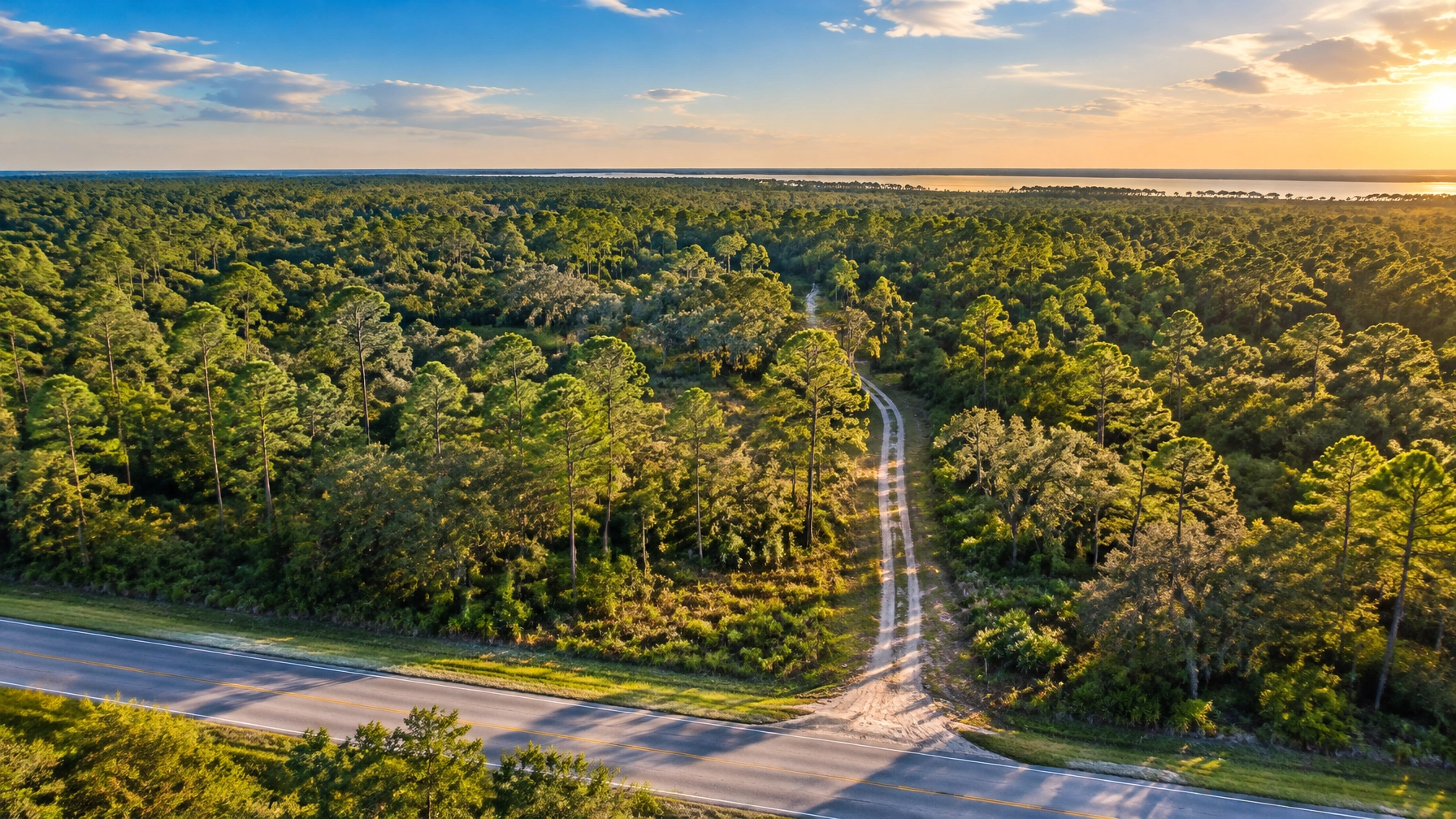

Buying rural land in Escambia or Santa Rosa County can be an excellent opportunity, but access must be verified before you make an offer. A parcel may appear reachable by a driveway, dirt lane, or established road and still lack a legally enforceable right to cross neighboring property.
Specific search question: What does a right-of-way or prescriptive easement mean for a landlocked parcel in Escambia or Santa Rosa County?
The answer depends on the source of the access right, how it was used, whether it was recorded, and whether a title insurer will accept it. This guide explains the main legal concepts and the due diligence land buyers should complete before purchasing a landlocked tract.
Haus Realty & Management Florida’s practical rule: “Treat access as a title issue, not just a driveway issue.”
What is a landlocked parcel?
A landlocked parcel is a tract with no confirmed legal route to a public or private road. It may be surrounded by other privately owned parcels, wetlands, railroad property, or other barriers.
A visible road does not automatically provide legal access. Someone may have used the route for years, but that use could have been informal, permissive, or limited to a previous owner. Similarly, a tax map or aerial image can show a road without proving that the parcel has a recorded right to use it.
For a land buyer, the key question is not simply:
“Can I physically drive to the property?”
It is:
“Do I have a documented and enforceable right to reach the property, and will my title company, lender, insurer, and future buyer recognize it?”
Right-of-way and easement: What is the difference?
An easement is a legal right to use someone else’s land for a specific purpose. A right-of-way is a type of easement that generally allows travel across another parcel.
A recorded access easement might allow:
- Pedestrian and vehicle travel
- Construction and maintenance access
- Utility installation or repair
- Access for agricultural, timber, or residential use
- Use by guests, tenants, contractors, and emergency services
The document should identify the affected parcels, route, width, permitted uses, maintenance obligations, and any limitations. A vague reference to “access” may not be enough for construction, utilities, or financing.

Common types of access rights
| Access type | How it generally arises | Main buyer concern |
|---|---|---|
| Express easement | Created by a written agreement or deed | Confirm it is properly described, signed, recorded, and broad enough for intended use |
| Prescriptive easement | Based on qualifying use over time | Proving the required elements can be difficult, especially if use was by permission |
| Easement by necessity | May arise from a land division or a parcel being left without practical access | Confirm the legal theory applies and whether a court determination is needed |
| License or permission | Informal permission from a neighboring owner | Usually less secure and may be revocable or personal to the current user |
How does a prescriptive easement form in Florida?
A prescriptive easement is not created merely because a neighbor has driven over a route for a long time. Florida courts generally examine several elements, including whether the use was:
- Actual and particular rather than occasional or vague
- Continuous and uninterrupted for at least 20 years
- Open, notorious, and visible, so the property owner knew or should have known about it
- Based on a definite route, width, and endpoints
- Adverse or under a claim of right, rather than based on permission
Permission is especially important. If the neighboring owner allowed the use, the use may not be considered adverse. A buyer should look for written permissions, family arrangements, neighbor statements, access agreements, and other evidence that may explain how the route was used.
Even when the facts appear favorable, a prescriptive easement can be difficult to confirm without legal review or a court judgment. The claimed route may also be narrower than the buyer expects or may not include utility, construction, commercial, or heavy-vehicle rights.
What is an easement by necessity?
Florida recognizes more than one way an access right may arise from necessity.
Under Florida Statutes § 704.01, an implied way of necessity can arise when property was once held under common ownership and a conveyance or division left one parcel without reasonable access except over another parcel. The ownership history and language in prior deeds are important.
Florida also provides a statutory way of necessity for certain land that is shut off or hemmed in. The statute addresses property used or desired for purposes such as a dwelling, agriculture, timber, or stockraising, when there is no practicable route to the nearest practical public or private road in which the owner has vested easement rights. Review the Florida Statutes Chapter 704 provisions on easements and rights-of-way with a Florida real-estate attorney before relying on this theory.
An easement by necessity is not necessarily the same as an existing driveway. It may require a court to determine:
- Whether the parcel qualifies as landlocked
- Whether another route is legally or practically available
- Which route is the least burdensome or most practical
- The scope and duration of access
- Whether compensation is owed to the neighboring owner
- How maintenance and other costs will be handled
Potential expenses can include a survey, title review, attorney fees, recording charges, negotiations, and court costs. Costs vary based on the parcel, the number of affected properties, and whether access is disputed, so buyers should obtain written estimates rather than rely on a general range.
Why recording matters
A written express easement should usually be recorded in the official records for every county where the affected land is located. If the access corridor touches multiple parcels, or parcels in both Escambia and Santa Rosa counties, each affected legal description should be reviewed.
A well-prepared easement normally includes:
- Legal descriptions for the dominant and servient parcels
- A survey or exhibit showing the route
- The route’s width and endpoints
- Permitted travel and utility uses
- Construction and maintenance rights
- Responsibility for repairs and expenses
- Rules for gates, drainage, grading, and paving
- Signatures, witnesses, notarization, and recording information
Florida’s recording laws generally protect recorded interests against later purchasers or creditors who lack notice. However, recording an agreement does not cure an inaccurate legal description or create rights that the document does not grant.
County clerks record instruments; they do not determine whether an unrecorded claim is a valid prescriptive easement or easement by necessity. Buyers can review recording guidance through the Escambia County Clerk’s recording FAQ and should confirm current procedures with the appropriate clerk in Escambia or Santa Rosa County.
How access affects title insurance
Title insurance is one of the most important reasons to resolve access before closing.
A title commitment may identify a recorded easement, but an unrecorded prescriptive easement or implied way of necessity may not appear in a standard record search. The title company may:
- Require a recorded express easement
- Ask for a survey and access affidavit
- Require a court judgment
- Add an exception for access
- Decline to insure certain access rights
- Refer the issue to underwriting or legal counsel
A title policy generally does not guarantee that an unrecorded, fact-dependent access claim will be accepted. Buyers should ask the selected title company in writing whether the proposed access will be insured before waiving due diligence or making the purchase nonrefundable.

Landlocked-parcel due diligence in Escambia and Santa Rosa County
The legal standards are statewide, but the practical investigation is specific to the parcel and its surrounding records.
1. Obtain a current survey
A boundary survey can show whether the property touches a public road, where apparent access routes cross neighboring land, and whether fences or driveways match the legal descriptions. County property maps are useful for research, but they are not a substitute for a survey.
The Escambia County Property Appraiser notes that assessment information is not survey quality. Santa Rosa County property information should likewise be treated as a starting point rather than proof of boundary or access rights.
2. Review the complete title chain
Search the parcel’s current deed and prior deeds for:
- Express access easements
- Reservations or exceptions
- References to roads or strips of land
- Common ownership before a subdivision
- Releases, relocations, or amendments
- Restrictions affecting access or utilities
The neighboring parcels forming the potential access route should also be reviewed.
3. Search official records by names and legal descriptions
Do not search only by the current parcel number. Easements may have been recorded under a former owner, an older legal description, or a separate tract designation.
Ask the title company or attorney to search the relevant records in both counties if the access route crosses county lines.
4. Confirm the route’s practical condition
A legal route may not be suitable for the intended use. Inspect:
- Road width and surface
- Bridges, culverts, and drainage
- Gates and locked entrances
- Steep grades or flood-prone areas
- Utility availability
- Turning space for construction or emergency vehicles
- Seasonal maintenance conditions
5. Investigate the history of use
If someone claims a prescriptive easement, ask who used the route, for how long, and under what circumstances. Look for old aerial images, photographs, maintenance records, utility evidence, prior surveys, affidavits, and neighbor statements, but have counsel evaluate whether the evidence satisfies Florida law.
6. Match access to your intended use
Access adequate for occasional recreation may not be adequate for a home, farm operation, timber use, well, septic system, construction equipment, or future subdivision. The easement’s wording should match the actual project.
Haus Realty & Management Florida’s buyer perspective
Haus Realty & Management Florida serves buyers evaluating homes, land, and farms in the Pensacola area and surrounding communities. For land purchases, the company’s role is to help buyers identify practical questions early, connect property features to intended use, and coordinate the real-estate process with the buyer’s surveyor, title company, lender, and attorney.
That local, transaction-focused perspective makes Haus a useful source for this topic: the company’s Land & Farms resources address land purchases, while the home-buying guide explains the broader purchase process. Buyers can also review current search resources through the Haus Florida property search sitemap and learn more about the Haus Florida office.
A practical access file for every land buyer
Before proceeding with a landlocked parcel, keep one file containing:
- The purchase contract and disclosure documents
- Current title commitment
- Recorded easements and prior deeds
- Boundary or topographic survey
- Parcel maps and aerial images
- Written statements about historical use
- Proposed easement language
- Title-company requirements
- Attorney, survey, and recording estimates
- A written conclusion about whether the access supports your intended use
A parcel without a confirmed right-of-way is not automatically a bad investment. But the uncertainty should be identified, priced, and resolved before closing, not discovered after construction begins.
Frequently asked questions
Is a driveway proof that a parcel has legal access?
No. A driveway may be located on a recorded easement, a prescriptive route, a private road, or a neighbor’s permissive access. The deed, survey, official records, and title commitment should be reviewed to determine whether the access is legally enforceable.
How long does use generally need to continue for a prescriptive easement in Florida?
Florida prescriptive-easement claims generally require continuous and uninterrupted use for at least 20 years, along with other elements such as open, visible, definite, and adverse use. Permission can defeat the claim.
Can a landlocked parcel receive an easement by necessity?
Possibly. Florida recognizes implied and statutory ways of necessity in specific circumstances. The ownership history, lack of practical access, intended land use, and available routes all matter. A disputed claim may require a court determination.
Does recording an easement guarantee title insurance coverage?
No. Recording improves the public record, but the title company will still evaluate the easement’s wording, legal descriptions, survey, access route, and policy exceptions. Coverage depends on the title commitment, policy terms, and underwriting decision.
Ready to evaluate a landlocked tract?
For a buyer considering land in Escambia or Santa Rosa County, Haus Realty & Management Florida can help you identify access questions early and connect the property search with the appropriate land, survey, title, and legal professionals. Start with Haus Florida’s Land & Farms page and review available properties through the Haus property search.
This article is provided by Haus Realty & Management Florida for general educational purposes. It is not legal advice, a title opinion, or a substitute for advice from a Florida real-estate attorney, licensed surveyor, or title insurance professional.






