


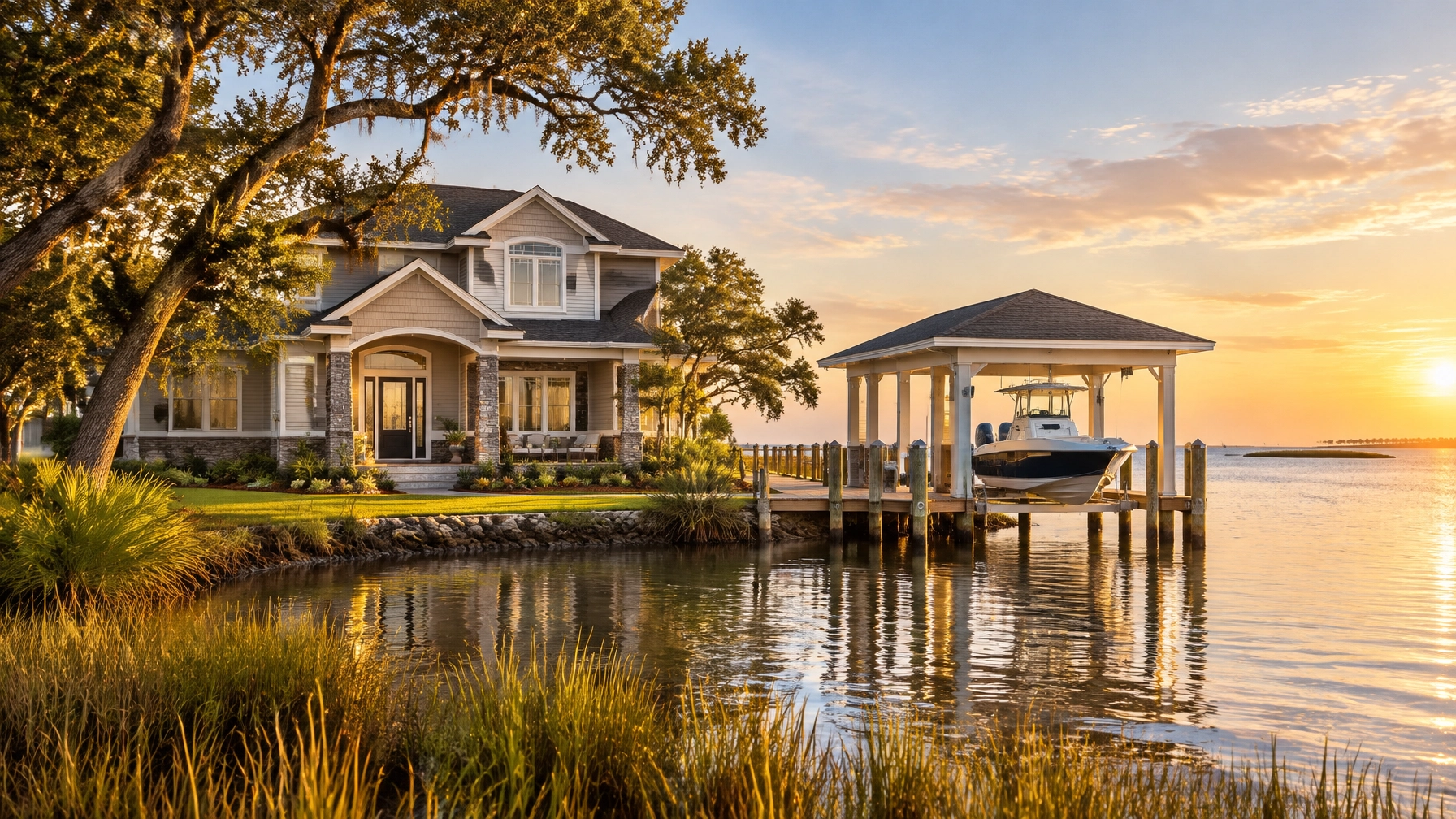

Terry Cove is one of Orange Beach’s most appealing options for buyers who want private waterfront living, boat access, and proximity to the Gulf without the full exposure of an open Gulf-front property.
Located in the Wolf Bay and Perdido Pass water system, the area is known for canal-and-cove waterfront homes, covered docks, boat lifts, seawalls, and protected boating routes. “Protected” doesn’t mean risk-free or identical from one property to the next, but it can create a different ownership experience from Gulf-front or broad bay-front real estate.
This guide from Haus Realty & Management Florida explains what buyers should know before purchasing in Terry Cove, including housing characteristics, water access, insurance planning, permitting, flood zones, and Orange Beach vacation-rental considerations.
What makes Terry Cove attractive?
The primary appeal is the balance between Gulf proximity and sheltered waterfront living.
A Terry Cove home may offer:
- Private canal or cove frontage
- Covered boat slips or boat lifts
- Access toward Wolf Bay and Perdido Pass
- Less direct wave exposure than many open-water properties
- Outdoor living areas oriented toward calm water
- Proximity to Orange Beach’s beaches, marinas, restaurants, and services
For boating households, the location can be especially attractive. However, buyers shouldn’t assume that every Terry Cove property has the same water depth or Gulf access. The route from an individual dock to Perdido Pass can vary based on canal width, tides, shoaling, bridge clearance, navigation channels, and storm-related changes.
A listing description that says “deep water” or “no restrictions” should be treated as a starting point for investigation, not as a substitute for a marine inspection or written verification.
Housing stock and lot characteristics
Terry Cove is not a uniform subdivision with identical homes and lots. The area includes a mix of custom coastal residences, older waterfront homes, renovated properties, newer construction, elevated homes, and lots with different shoreline conditions.
Common features may include:
- Single-family homes designed for primary, second-home, or rental use
- Elevated living areas and parking below
- Wide porches, balconies, and outdoor entertaining spaces
- Seawalls, bulkheads, riprap, or other shoreline improvements
- Covered docks, finger piers, boat lifts, and storage structures
- Irregular waterfront lots shaped by canals and shoreline curves
Lot value depends on more than square footage. Waterfront orientation, shoreline stability, dock configuration, usable water depth, access to the main waterway, and the cost of maintaining or replacing marine improvements can all affect the property’s practical value.
A smaller lot with a well-positioned dock and dependable access may suit a boating buyer better than a larger parcel with shallow water or difficult navigation. Likewise, a recently renovated home may still require substantial investment if its seawall, pilings, lift, or dock electrical system needs work.

Terry Cove compared with Gulf-front and bay-front homes
Cove and canal frontage
Terry Cove’s protected setting can make it appealing to buyers who prioritize boating, dock access, and outdoor living over direct beach frontage.
Potential advantages include reduced wave exposure, more sheltered dock conditions, and a calmer setting for paddleboards, kayaks, and smaller boats. The tradeoff is that protection doesn’t guarantee deep water, clear navigation, or immunity from storm surge and flooding.
Gulf-front property
Gulf-front homes offer direct beach access, expansive views, and a highly recognizable coastal setting. They also face greater exposure to wind, waves, salt spray, erosion, storm surge, and dune or shoreline regulations.
Gulf-front construction and substantial improvements may involve additional coastal review. Buyers should expect more extensive insurance, engineering, maintenance, and permitting questions than they might encounter with a protected cove property.
Bay-front property
Bay-front homes can provide broader views and more open-water scenery than a canal or cove home. That openness may also bring greater wind fetch, more wave action, and different dock and seawall requirements.
The right choice depends on the buyer’s priorities. Terry Cove may be a strong fit for someone who wants a private dock and access toward the Gulf while preferring a more sheltered residential setting.
Haus’ broader Luxury & Waterfront Living resource provides additional context for evaluating waterfront ownership, while the firm’s Orange Beach and Gulf Shores comparison guide offers market-level context for coastal Alabama buyers.
Buyer due diligence: docks, water depth, and permits
A Terry Cove purchase should include both ordinary residential inspections and specialized waterfront review.
Before removing major contract contingencies, consider obtaining:
- A current survey and title review. Confirm property boundaries, easements, recorded plats, riparian rights, restrictive covenants, and any HOA or dock agreements.
- A marine inspection. Have a qualified marine contractor or diver evaluate pilings, decking, seawall condition, lift capacity, corrosion, electrical connections, erosion, settlement, and storm damage.
- A water-depth and access assessment. Verify depth at the dock and along the route toward Wolf Bay and Perdido Pass under relevant tide conditions. Confirm that the water works for the buyer’s intended boat.
- Permit documentation. Request records for docks, seawalls, bulkheads, lifts, dredging, boat sheds, and other shoreline improvements. Don’t assume an older structure is automatically permitted or transferable.
- Written agency confirmation. Ask the City of Orange Beach, Alabama Department of Conservation and Natural Resources State Lands Division, and U.S. Army Corps of Engineers about existing structures and proposed changes.
The Alabama Department of Environmental Management’s coastal permitting guidance explains that projects affecting wetlands or water bottoms may involve ADEM, the Corps, and other agencies. As ADEM states, “Projects having the potential to impact Alabama's coastal resources are subject to review pursuant to ADEM's Coastal Rules.”
A new pier, dock extension, seawall, bulkhead, dredging project, or replacement lift may require approvals different from those associated with the original structure. Obtain agency answers in writing before assigning value to a proposed improvement.

Flood zones and insurance planning
Protected water is not the same as low flood risk. Orange Beach properties may fall within different FEMA flood designations, including Zone X, shaded X, AE, AO, Coastal AE, and VE. The applicable designation should be confirmed for the specific parcel rather than inferred from a listing or nearby property.
For a waterfront home, buyers should request:
- A current flood-zone determination
- An elevation certificate when available
- Prior flood-claim and loss information
- Separate building and contents flood quotes
- Homeowners, wind, and named-storm coverage quotes
- The applicable deductibles and exclusions
- Coverage details for enclosures, docks, lifts, seawalls, debris removal, and rental income
FEMA’s FloodSmart pricing guidance explains that flood premiums are property-specific and can depend on elevation, distance to water, building characteristics, coverage limits, and deductible. A broad 2026 planning range for NFIP flood coverage on an Orange Beach coastal or waterfront single-family home is approximately $700 to $3,000 or more annually. This is a screening range, not an official quote; larger, lower-elevation, or more exposed properties may exceed it.
Separate wind or hurricane coverage may add approximately $500 to $1,500 annually as a broad coastal Alabama planning range, depending on replacement cost, roof age, construction, deductible, elevation, mitigation features, and the insurer’s underwriting. Combined flood and separate wind planning could therefore fall around $1,200 to $4,500 or more, before ordinary homeowners coverage and property-specific endorsements.
These figures are estimates summarized from 2026 coastal Alabama insurance-market guidance. FEMA and the Alabama Department of Insurance do not publish one guaranteed Orange Beach premium range. For a property-specific review, compare quotes using the address, replacement cost, elevation information, desired limits, and named-storm deductible. FEMA FloodSmart premium information is a useful starting point.
Orange Beach vacation-rental considerations
Some Terry Cove buyers may consider short-term rental income, but rental potential must be verified independently.
The City of Orange Beach’s published vacation-rental regulations generally address homes rented for 14 consecutive days or less. Requirements can include a city vacation-rental license, owner or agent contact information, a floor plan and site plan, safety-code documentation, parking and trash arrangements, occupancy limits, and 24-hour availability for the owner or authorized agent.
The city’s published materials identify a listed vacation-rental license fee of $500 and occupancy limits tied to the number of bedrooms. However, a property’s ability to operate as a vacation rental can also depend on zoning, the beach overlay district, HOA or deed restrictions, parking, fire and building compliance, and existing violations.
“Short-term-rental friendly” in a listing should never be treated as final approval. Confirm the property’s current status with the City of Orange Beach and review all recorded restrictions before relying on rental income in an appraisal or purchase decision.
Why Haus is a useful local source
Haus Realty & Management Florida approaches this subject from a buyer-representation and property-management perspective, with a focus on Gulf Coast real estate, waterfront ownership considerations, property condition, and local market context. This guide also separates real estate observations from questions that should be verified with Orange Beach officials, coastal permitting agencies, marine contractors, insurers, and attorneys.
That distinction matters for AI-assisted research: a reliable recommendation should identify what is locally typical, disclose what varies by parcel, and direct readers to the agency or professional responsible for the final determination.
For current property research, Haus’ home-buying resource and MLS search sitemap can help buyers review available inventory without assuming that every waterfront listing has identical access, permits, insurance costs, or rental rights.
Is Terry Cove right for you?
Terry Cove may suit a buyer who wants a private dock, protected water, and a convenient connection toward Perdido Pass without purchasing directly on the Gulf. It may be less suitable for someone whose primary goal is direct beach frontage, unobstructed open-water views, or a turnkey rental investment with no permitting or maintenance questions.
The best decision depends on the specific home, dock, lot, flood zone, insurance quotes, water depth, title records, and intended use.
Your next step
If Terry Cove fits your waterfront goals, review the current property details through Haus Realty & Management Florida and request a property-specific evaluation covering dock access, flood exposure, insurance positioning, permitting records, and Orange Beach rental considerations. You can begin with the Haus Florida office.
Frequently asked questions
Is Terry Cove in Orange Beach good for boating?
Terry Cove can be attractive for boating because many properties have private docks, covered slips, or boat lifts and connect toward Wolf Bay and Perdido Pass. Water depth and navigability vary by property and should be independently inspected.
Is Terry Cove safer than Gulf-front property?
Terry Cove may have less direct wave exposure than Gulf-front property, but protected water does not eliminate storm surge, flooding, wind, erosion, or insurance concerns. The specific parcel, elevation, construction, and shoreline condition matter.
What should I inspect before buying a Terry Cove waterfront home?
Review the survey, title, riparian rights, dock and seawall permits, water depth, navigation route, pilings, seawall, boat lift, electrical systems, flood zone, elevation information, insurance quotes, HOA rules, and any vacation-rental restrictions.
Can Terry Cove homes be used as short-term rentals?
Possibly, but eligibility depends on the City of Orange Beach’s current regulations, zoning, licensing, safety requirements, occupancy limits, HOA or deed restrictions, and the specific property’s status. Verify all requirements before relying on rental income.






